
How To Use A Bidet As A Woman: If you have ever wondered how to use a bidet as a woman, you are not alone. Bidets are one of the most misunderstood bathroom tools in the English-speaking world, particularly in the United States, Canada, the UK, and Australia — despite being completely standard in Europe, Asia, and South America for decades.
And if you have ever caught yourself thinking — “Will the water actually go inside?” or “Can using a bidet give me a UTI?” or even “I have no idea how to even sit on one” — then you are in exactly the right place, because those are precisely the kinds of questions millions of women are silently searching for answers to every single day.
The truth is, most women who hesitate before trying a bidet are not hesitating because of the bidet itself. They are hesitating because nobody has ever given them a complete, honest, woman-specific answer to every doubt they have. A quick Google search gives you fragments. A product manual tells you nothing about feminine hygiene safety. A friend who uses one says “just try it” without explaining how. That gap in real information is exactly what this guide exists to close.
This is not a basic overview. This is the most complete women’s bidet guide available — covering every major question, every common concern, every health topic, and every practical scenario a woman could face when it comes to bidet use. From your very first time sitting on one, to using it safely during your period, through pregnancy, postpartum recovery, and beyond — every doubt you have arrived here with will be fully answered before you leave.
The good news is that once you understand how a bidet works and how to position yourself correctly, using one becomes second nature within just a few days. This guide covers everything a woman needs to know: what a bidet is, how the different types work, the correct step-by-step process, and the critical hygiene rules that make bidet use safe, clean, and genuinely better than toilet paper alone.
Read every section that applies to your life right now — and bookmark this page, because every section you skip today may be exactly what you need tomorrow.
How To Use A Bidet As A Woman
What Is A Bidet
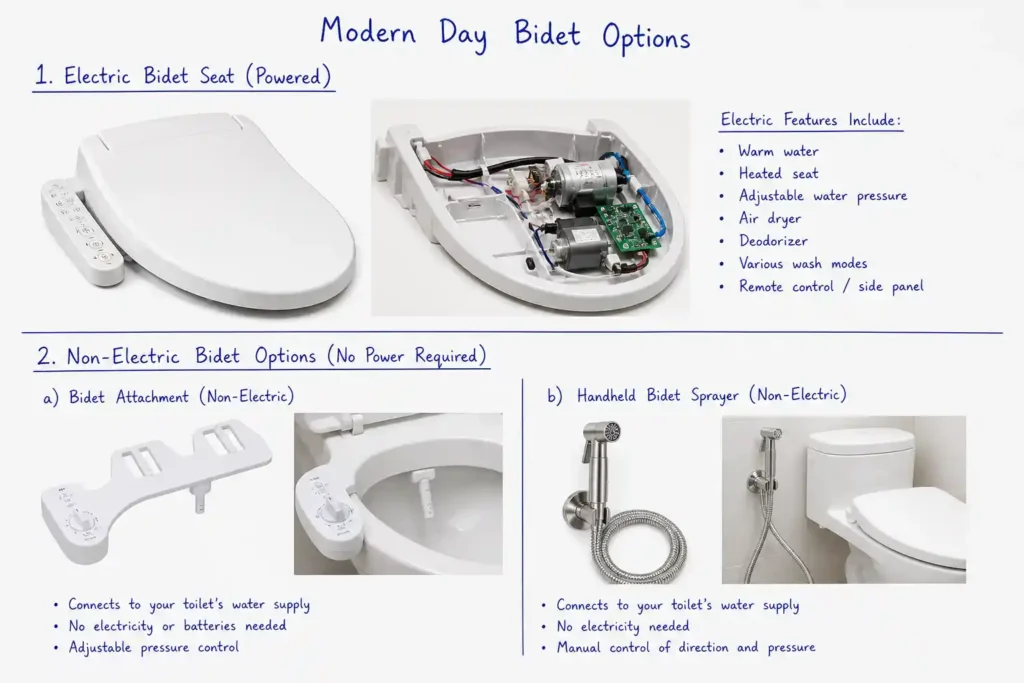
A bidet is a bathroom fixture designed to clean your genital and anal area using a stream of water after you use the toilet. The word “bidet” originates from French and literally means “pony” — a reference to how you straddle it. While the concept sounds unfamiliar to many women in Tier 1 Western countries, bidets have been used safely and hygienically across Europe, Japan, South Korea, Brazil, and the Middle East for well over a century.
Today, the bidet is no longer a foreign luxury item. It has evolved into modern, affordable, easy-to-install attachments and seats that fit any standard toilet. The core function is simple: water replaces or significantly reduces the need for toilet paper, providing a cleaner, gentler, and more hygienic experience — especially for women who have more sensitive hygiene needs than men.
Types Of Bidets (Seat, Attachment, Standalone, Handheld)
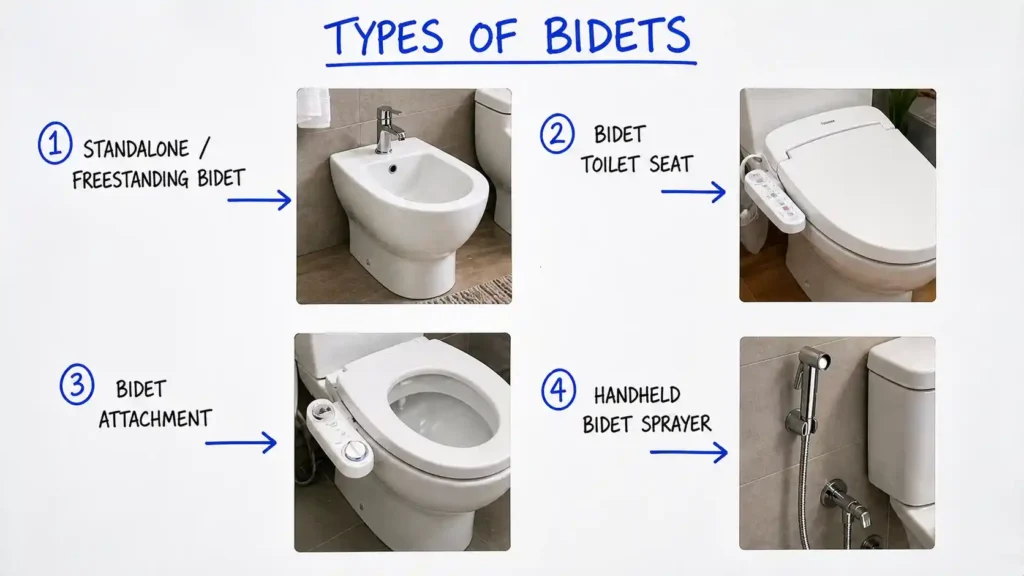
Understanding the different types of bidets will help you choose the right one. There are four main types:
- Standalone / Freestanding Bidet: A separate porcelain or ceramic fixture placed next to the toilet. Common in European and South American bathrooms. You finish using the toilet, then move to the bidet.
- Bidet Toilet Seat: Replaces your existing toilet seat entirely. Includes built-in nozzles, controls, and often electric features like heated seat and warm water. This is the most feature-rich option for women.
- Bidet Attachment: A slim device that attaches under your existing toilet seat between the seat and the toilet bowl. Affordable, easy to install, and does not require electricity. A great starting point for women new to bidets.
- Handheld Bidet Sprayer: A small nozzle attached to the toilet’s water supply by a hose. You hold it and aim the water yourself, giving full manual control over direction and pressure.
For women, a bidet seat or attachment with a dedicated feminine wash nozzle is the most recommended option.
How It Works Mechanically
At its core, a bidet connects to your home’s water supply — the same supply line that feeds your toilet tank. When you activate the bidet, water is drawn from this supply line and directed through a nozzle that is positioned inside or under the toilet seat rim.
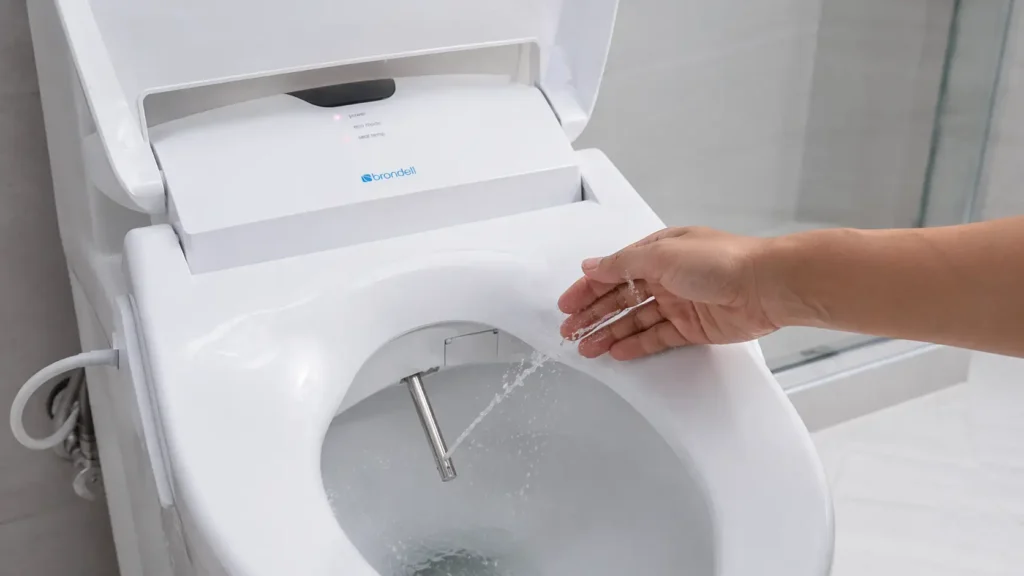
On most modern bidet seats and attachments, the nozzle extends automatically when activated and retracts when not in use, keeping it clean. On standalone bidets, water fills the basin or rises through jets built into the bowl. The water that comes out of a bidet nozzle is the same clean tap water that flows from your bathroom sink or shower. It is not recycled toilet water. It is not waste water. It comes directly from the supply line, making it completely safe to use for cleaning.
Step-By-Step Use Process
Here is the standard step-by-step process for a woman using a bidet seat or bidet attachment:
- Use the toilet as you normally would. There is no need to pre-wipe before using the bidet, though some women prefer a single gentle wipe first.
- Remain seated on the toilet. With a bidet seat or attachment, you do not move to another fixture.
- Activate the bidet using the side panel, remote control, or knob depending on your model.
- Start with low water pressure and adjust upward as needed. This prevents any startling shock from high-pressure spray.
- Select the correct wash mode. Women should use the front/feminine wash setting to clean the genital area, or the rear wash setting for the anal area.
- Allow the water to spray for 20 to 60 seconds for thorough cleaning.
- Turn the bidet off and pat the area dry with a small amount of toilet paper, a dedicated bidet towel, or use the air-dry feature on electric models.
Front Wash Vs Rear Wash
This is one of the most important distinctions for women using a bidet. The rear wash is designed to clean the anal area after a bowel movement. It is the standard function on all bidets, regardless of gender. The front wash, also called the feminine wash, is a separate function specifically designed for women. It uses a differently angled nozzle positioned further forward, targeting the external genital area for gentle cleansing.
The two nozzles are independent on dual-nozzle bidets, meaning they spray from different positions. Never use the rear wash to clean the front — this can direct water and bacteria from the anal region toward the urethra, significantly increasing the risk of urinary tract infections. Always use the dedicated feminine wash for front cleaning, and always direct spray from front to back.
Water Pressure Adjustment
Adjusting the water pressure is essential for safe and comfortable bidet use, especially for women whose front genital area is considerably more sensitive than the anal region.
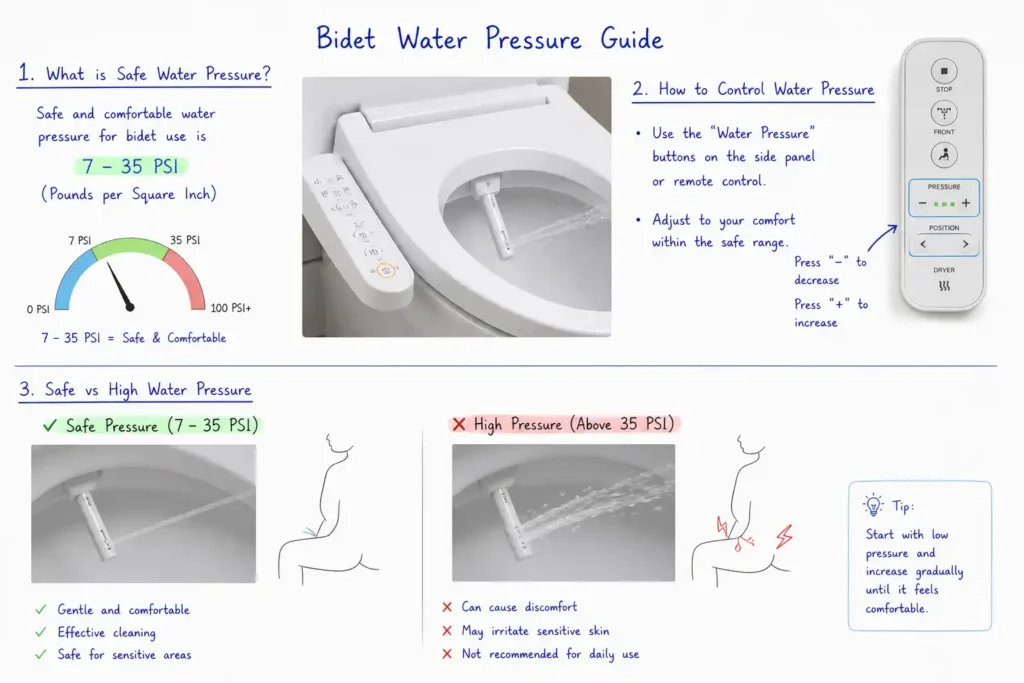
Most bidet seats and electric attachments allow you to adjust pressure through a dial, side panel, or remote control. Non-electric bidet attachments typically adjust pressure by turning a manual knob. Always start at the lowest pressure setting, particularly for the feminine wash. A gentle, low-pressure stream is all that is needed to effectively clean the external genitalia. Higher pressure is unnecessary and can cause irritation or discomfort. For the rear wash, you can gradually increase pressure to your preference. Think of the bidet spray as a very gentle stream, similar to water flowing softly from a tap over your hand — not a power wash.
Water Temperature Setting
Water temperature makes a significant difference in comfort, particularly in colder climates common across the USA, Canada, the UK, and Northern Europe. Basic non-electric bidet attachments only supply cold water, which can feel very abrupt, especially in winter. Electric bidet seats typically include a warm water heating system that allows you to choose your preferred temperature. Warm water is generally more comfortable and soothing, especially during menstruation, postpartum recovery, or for women with hemorrhoids. However, research has noted that consistent use of warm water bidets may slightly affect vaginal microflora in some women. If you are concerned about this, using cool or room-temperature water for the feminine wash is a reasonable precaution. For the rear wash, warm water is perfectly safe and generally recommended for comfort.
How To Dry After Using A Bidet
Many women wonder whether they stay wet after using a bidet. The answer depends on your drying method. There are three main options:
- Toilet paper pat-dry: Use a small number of sheets to gently pat — not rub — the area dry. This method significantly reduces toilet paper consumption while still keeping you completely dry and clean.
- Dedicated bidet towel: Some households keep a small, soft cloth towel exclusively for post-bidet drying. These are washed regularly and are an eco-friendly alternative to toilet paper.
- Air dryer: Many electric bidet seats include a warm air drying feature that gently blows air to dry the area hands-free. It takes slightly longer but eliminates the need for any paper or cloth.
Never rub aggressively when drying. The area has already been thoroughly cleaned by the water. Gentle patting is all that is required to remove surface moisture without causing irritation.
Common Mistakes Women Make
Women new to bidet use often make a handful of avoidable mistakes. The most dangerous is spraying from back to front, which moves fecal bacteria toward the urethra and can cause UTIs.
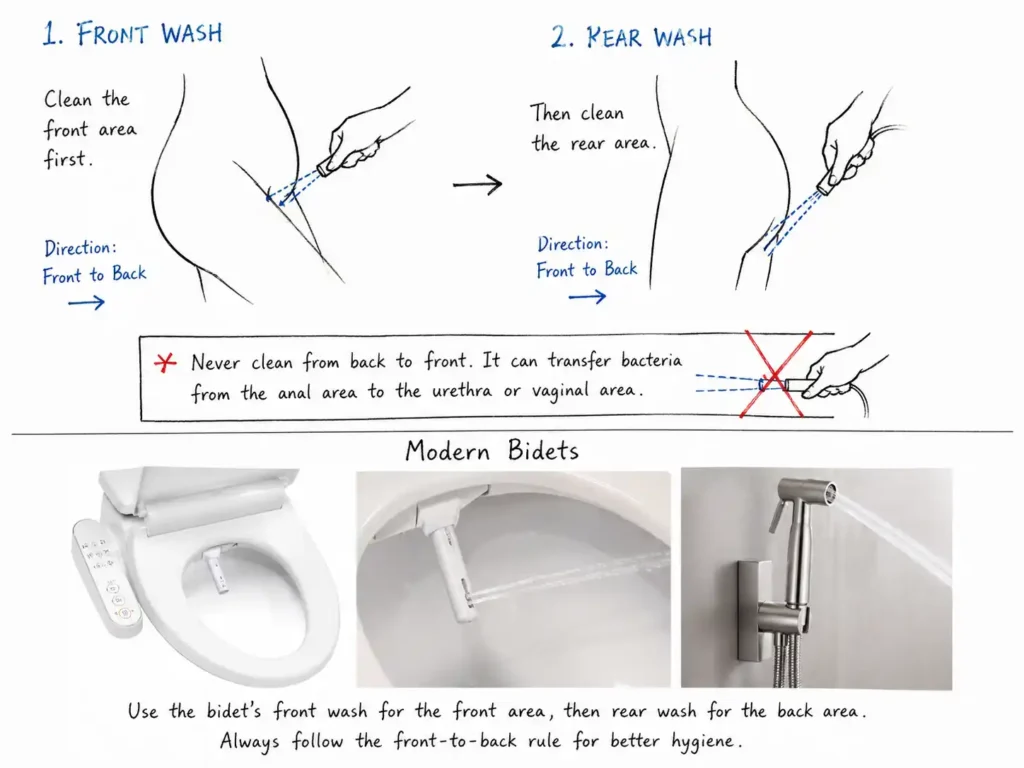
Another common error is using too much water pressure on the front/feminine wash, which can cause discomfort or irritation. Many women also forget to select the correct wash mode, accidentally using the rear nozzle for the front area. Skipping regular nozzle cleaning is another frequent issue — even self-cleaning nozzles benefit from a manual wipe-down weekly. Finally, some women over-use the bidet by spraying internally inside the vagina, which can disrupt vaginal pH and natural microflora. A bidet is designed to clean the external area only. Never direct high-pressure water internally.
Front-To-Back Rule Explained
The front-to-back rule is the single most important hygiene principle for women using a bidet. It mirrors the same rule taught for wiping with toilet paper: always clean from the front (urethra and vaginal area) toward the back (anal area), never in the reverse direction. This rule exists because the anus harbors fecal bacteria, including E. coli, that can cause serious infections if transferred to the urethra or vagina. When using a bidet’s feminine wash, the nozzle is already positioned at the front and sprays away from the anal region — making it naturally front-to-back by design. However, on standalone bidets or handheld sprayers, it is your responsibility to direct the water correctly. Always rinse the front area first, then the rear, and never cross-contaminate between the two.
How To Use A Bidet For The First Time: A Woman’s Guide
Using a bidet for the first time can feel unfamiliar, and that is completely normal. Most women raised in the United States, the UK, Canada, or Australia have never used one, and the idea of water cleaning an area they have only ever wiped with paper can feel strange or even intimidating. The important thing to know is that virtually every woman who tries a bidet correctly reports feeling cleaner, fresher, and more comfortable than with toilet paper alone. The first-time experience is all about going slowly, starting at low pressure, finding your correct positioning, and giving yourself a few tries to build confidence. This section walks you through everything you need to know for a smooth, comfortable, and successful first experience with a bidet.
What To Expect The First Time
The most common first-time reaction to a bidet is surprise — not because anything goes wrong, but simply because the sensation of water cleaning that area is genuinely new and unexpected. Most women describe it as feeling like a very gentle, targeted stream of water, similar to a light shower spray. If your bidet is supplying cold water and you are in a cold climate, the first spray can feel quite cold and abrupt. If you have an electric bidet with warm water, the experience is immediately more comfortable. Do not expect to get it perfectly right on the first try. You may need to adjust your position slightly, change the pressure, or move the nozzle angle before the water hits exactly where it needs to go. This is normal. Give yourself three to five uses before judging whether a bidet is right for you.
How To Turn On The Bidet
Depending on which type of bidet you have, turning it on works differently. For a bidet seat or electric attachment, you will typically use a side-mounted control panel or a wireless remote control. Look for buttons labeled “rear wash,” “front wash” or “feminine wash,” “pressure,” and “temperature.” For a non-electric bidet attachment, there is usually a single knob or T-valve on the right side of the toilet. Turning this knob counterclockwise activates the water flow. For a standalone bidet, there is a faucet or set of knobs that you turn to start the water. For a handheld bidet sprayer, you hold the sprayer in position first, then squeeze or press the trigger handle to release the water. Before your first use, familiarise yourself with the controls while dry so you are not discovering them under pressure.
Starting With Low Pressure
Starting with the lowest possible pressure setting is the single most important tip for first-time bidet users. This applies to all women, regardless of bidet type. The sensation of water pressure on sensitive areas is very different from what most people imagine before trying a bidet, and what feels like a moderate setting on paper can feel quite intense in practice. On electric bidets, locate the pressure control and set it to the minimum. On non-electric attachments, turn the knob or valve very slowly and gently at first. Non-electric bidets draw directly from your household water pressure, which varies by home and region, so they can sometimes feel stronger than expected even at the lowest setting. Starting low and working upward gives you full control over your comfort and prevents any unpleasant surprise.
Adjusting Nozzle Position
Most modern bidet seats and attachments allow you to adjust the nozzle position to direct the spray forward or backward within a range. On electric models, this is typically done through the control panel using “nozzle forward” and “nozzle backward” buttons. Finding the correct nozzle position is key to effective cleaning, because if the spray misses the target area, no cleaning is actually happening. For the feminine wash, you want the nozzle angled so the spray targets the external vaginal area. For the rear wash, the nozzle should aim at the center of the anal area. If your bidet has a fixed nozzle, you adjust its coverage by shifting your own seating position slightly — rocking forward slightly for front wash coverage and sitting more centrally for rear coverage.
How Long To Spray (20 To 60 Seconds)
A common first-time question is: how long should you actually let the water run? The general recommendation is between 20 and 60 seconds per wash cycle. Twenty seconds is typically sufficient for a quick rinse after urination or a light bowel movement. Closer to 60 seconds is recommended after a heavier bowel movement or during menstruation when more thorough cleaning is needed. There is no strict rule — you stop when the area feels clean. Unlike toilet paper where you check for cleanliness visually, with a bidet you rely on the physical sensation of clean, running water leaving no residue. After your first few uses, you will naturally develop a feel for how long is enough. Over-spraying is not harmful, but it is unnecessary and wastes water.
The Bidet Shimmy Positioning Tip
The “bidet shimmy” is a term coined by bidet brand BioBidet and widely used in the bidet community to describe the small, subtle shifting movement you make while seated to direct the water spray to exactly the right position. Think of it as a tiny rocking or sliding motion — forward, backward, or slightly side to side — done while the water is running. This is not awkward or unusual. It is the standard technique for getting full coverage from a fixed or minimally adjustable nozzle. Women especially benefit from the bidet shimmy because the front and rear cleaning zones are more distinct. A small lean forward directs water to the front. A slight lean back focuses it on the rear. Mastering this gentle adjustment is the difference between good coverage and excellent coverage.
Electric Vs Non-Electric First-Time Experience
Your first-time bidet experience will differ significantly depending on whether your bidet is electric or non-electric. Electric bidet seats offer warm water, adjustable pressure, heated seats, nozzle position control, and often air drying — making for a significantly more comfortable and customizable first experience.
Non-electric bidet attachments are simpler and more affordable, but they supply only cold water (unless connected to a hot water line separately), and their pressure is controlled by your home’s water supply, which can feel quite strong. For women in cold climates, a first-time experience with an unheated bidet in winter can be jarring. If you have the budget, starting with an electric bidet seat makes the adjustment period much smoother. If you start with a non-electric attachment, be especially slow with the pressure control.
Overcoming Fear Or Hesitation
Many women feel hesitant about trying a bidet, and that hesitation is understandable. Common concerns include: Will the water go inside? Will it spray everywhere? Is it actually clean? Is it weird? These are all valid first-time thoughts, and the answer to all of them is reassuring. A correctly designed bidet does not spray internally — it washes the external area only. The water comes from your clean household supply line, not the toilet bowl. The nozzle is positioned carefully within the seat or attachment. Doctors, dermatologists, and gynecologists consistently recommend bidet use for women as a safer, gentler alternative to toilet paper. The American College of Obstetricians and Gynecologists (ACOG) supports gentle external washing as part of healthy feminine hygiene. The hesitation fades almost entirely after the first two or three successful uses.
Drying Off After First Use
After your first bidet rinse, you will need to dry the area. Most first-time users are surprised by how little drying is actually needed, because the bidet does not soak the area — it rinses it. A small amount of moisture remains on the skin surface, and this can be removed with two to three sheets of toilet paper used to gently pat. If your electric bidet has an air drying function, press the dry button and allow 30 to 60 seconds of warm air to complete the drying. The key word is “pat,” not “rub.” Rubbing introduces the same friction and potential irritation that is one of the main reasons women switch from toilet paper to bidets in the first place. Over time, many women reduce their toilet paper use to just the pat-dry step, cutting household toilet paper consumption by 75 percent or more.
First-Time Mistakes To Avoid
Being aware of common first-time mistakes will save you from a poor first experience:
- Turning the pressure up too fast. Always start low and adjust upward slowly.
- Not selecting the correct wash mode. Using the rear nozzle on the front area is both ineffective and unhygienic.
- Spraying for too long expecting more to happen. Twenty to thirty seconds is genuinely enough for most situations.
- Not adjusting your position. If the water does not feel like it is hitting the right spot, shift slightly rather than increasing pressure.
- Expecting it to feel like toilet paper. It will not — and that is the point. Water is more effective than paper. Trust the process.
- Not drying afterward. Remaining wet can cause skin moisture irritation over time. Always pat dry after each use.
Give yourself at least five full uses before deciding whether a bidet is right for you. Almost every woman who commits to a proper trial period becomes a permanent bidet user.
Are Bidets Sanitary For Females
This is one of the most searched questions women ask before buying their first bidet, and it deserves a thorough, honest answer. The short answer is: yes, bidets are sanitary for females when used correctly. In fact, research and medical professionals consistently indicate that water cleaning is more hygienic than toilet paper for both the genital and anal area. However, the nuance matters. Improper bidet use — specifically spraying in the wrong direction, using a dirty nozzle, or directing water internally — can introduce hygiene risks. The goal of this section is to give you a complete, evidence-based answer so you can use your bidet with full confidence. We will look at how bidets compare to toilet paper, address the key hygiene rules, examine relevant studies, and explain what doctors actually say on the subject.
How Bidets Clean Vs Toilet Paper
The fundamental difference between a bidet and toilet paper is that water physically removes bacteria and residue from the skin surface, while toilet paper primarily smears and redistributes it. Think of washing your hands after handling something dirty — you would not simply wipe them with a dry cloth and consider them clean. You use water. The same logic applies to post-toilet hygiene.
A bidet delivers a targeted stream of clean water directly to the area, washing away fecal matter, bacteria, urine, and discharge without any friction or surface contact. Toilet paper, by contrast, requires physical wiping — a motion that research has shown can spread bacteria rather than eliminate it. According to Healthline, bidet use results in significantly less bacterial contamination on the hands and skin than toilet paper use alone, making it a genuinely superior hygiene method for women.
Front-To-Back Spraying Direction
The direction of the water spray is the single most important hygiene rule for women using a bidet. The principle is identical to the wiping rule every woman learns from childhood: always clean from front to back, never back to front. The anus contains fecal bacteria, including E. coli and other pathogens, that cause serious infections if transferred to the urethra or vaginal area.
Women are anatomically more vulnerable to this risk because the urethra, vagina, and anus are in closer proximity than in men. When using a bidet’s dedicated feminine wash setting, the nozzle is already positioned at the front of the toilet seat and sprays in a forward-to-back direction by design. However, when using a handheld sprayer or a standalone bidet, the user must manually control direction. Always rinse the front area first, then the rear — never in reverse.
Does Bidet Water Touch Dirty Areas
One of the most common first-time concerns is whether the water from the bidet nozzle comes into contact with the inside of the toilet bowl or any waste before reaching you. The answer is no — bidet water does not touch the toilet bowl, waste, or dirty surfaces at any point. The nozzle draws water directly from your home’s clean water supply line, which is the same line that supplies your bathroom sink and shower. On bidet seats and attachments, the nozzle is housed inside the seat unit and only extends outward when activated, spraying a fresh stream of water directly onto your skin. It does not recycle or recirculate any water from the toilet bowl. The water exiting a bidet nozzle is as clean as the water from your kitchen tap. This is a fundamental design feature of all modern bidets, and it is why bidet use is considered hygienically superior to toilet paper.
Nozzle Self-Cleaning Feature
Most modern electric bidet seats and many higher-end bidet attachments include a self-cleaning or auto-rinse nozzle function. This feature automatically runs a brief rinse cycle over the nozzle before and after each use, flushing away any surface residue with fresh water. The nozzle is typically made from a non-porous material that resists bacterial growth, and on many models it retracts fully inside a protective housing when not in use, preventing dust, splash, or contamination from reaching it between uses. Self-cleaning is a reassuring feature, but it is important to understand that it does not replace manual cleaning entirely. The self-clean cycle flushes the nozzle surface, not the interior of the bidet unit. A quick manual wipe of the nozzle with a mild antibacterial cleaner once a week is still recommended as part of your bathroom hygiene routine.
How Often To Clean Your Bidet Nozzle
Even with a self-cleaning feature, manual nozzle cleaning should be done at least once per week for households with regular use. To clean the nozzle on an electric bidet seat, most models have a “nozzle cleaning” or “nozzle extend” button that holds the nozzle in the extended position so you can access it without activating the spray. Use a soft cloth or cotton pad dampened with a mild, non-abrasive bathroom cleaner or diluted white vinegar to gently wipe the nozzle surface. Avoid bleach-based cleaners, as these can damage the nozzle material over time. For non-electric attachments, the nozzle can usually be unscrewed or detached for more thorough cleaning. In households with multiple users or heavy daily use, cleaning every two to three days is a better standard. A clean nozzle is the foundation of safe and hygienic bidet use for the whole family.
A frequently asked question in family households is whether sharing a bidet is hygienic. The answer is yes, provided basic hygiene practices are followed. Because the bidet nozzle does not come into direct physical contact with the user’s body — it sprays water from a short distance — there is no transfer of skin cells, bacteria, or bodily fluids between users the way there would be with a shared towel, for example. However, a few practices are important. First, never share a pat-dry towel between users — each person should use fresh toilet paper or their own dedicated towel. Second, the nozzle should be cleaned regularly, especially in larger households. Third, if any family member has a known infection, they should inform others and cleaning frequency should increase during that period. With these simple precautions, a shared bidet is completely safe for the whole family.
Study On Bidet Use And Vaginal Bacteria
It is important to address this honestly, because some studies have raised a concern worth knowing about. A study conducted on female bidet users in Japan and South Korea found that women who regularly used warm water bidets had altered vaginal microflora — specifically, decreased beneficial lactobacillus bacteria and increased presence of fecal bacteria in the vaginal area compared to non-bidet users. This sounds alarming, but the context matters. The study was limited in sample size, focused specifically on warm water bidet users, and has not been replicated at scale. Importantly, it examined women who were directing water at the vaginal opening — an incorrect technique. When used correctly — externally only, with front-to-back direction and appropriate pressure — the scientific and medical consensus remains that bidets are safe for women. If you are concerned, using cool or room-temperature water for the feminine wash is a simple precaution. You can read more about vaginal microbiome health at the National Institutes of Health (NIH).
Warm Water Vs Cold Water Safety For Women
The temperature of the bidet water matters more for women than many people realize. Warm water is more comfortable, particularly during menstruation, pregnancy, and postpartum recovery, and this is why most electric bidet seats include adjustable water heating. However, as noted in the vaginal microflora research above, there is a potential concern that warm water used on the front genital area may slightly disrupt the natural bacterial balance in some women. Cold or room-temperature water, by contrast, does not appear to carry the same risk and is perfectly safe for external feminine hygiene. The safest approach for most women is to use a lower, room-temperature or mildly warm setting for the feminine/front wash, reserving warmer temperatures for the rear wash where there is no vaginal flora concern. This gives you comfort without any unnecessary risk.
Doctor’s Perspective On Bidet Sanitation
The medical community’s view on bidet use for women is overwhelmingly positive, provided correct technique is followed. Gynecologists and dermatologists widely recommend bidets as a gentler, more hygienic alternative to toilet paper, particularly for women who suffer from frequent UTIs, skin irritation, hemorrhoids, yeast infections, or bacterial vaginosis. The American Academy of Dermatology recommends gentle water cleansing over abrasive wiping for sensitive skin conditions. OB/GYN specialists consistently support bidet use postpartum as a safer and less painful alternative to toilet paper during perineal healing. The key medical guidance is consistent across all sources: use water externally only, maintain front-to-back direction, keep pressure gentle, and clean the nozzle regularly. When these four rules are followed, bidet use is not only safe — it is actively beneficial for women’s health.
Bidet Vs Wet Wipes Sanitation Comparison
Many women who are concerned about toilet paper hygiene turn to feminine wet wipes as an alternative. While wet wipes feel cleaner than dry toilet paper, they come with their own significant concerns that bidets do not share. Most commercially available feminine wipes, even those labeled “flushable,” contain preservatives, fragrances, and chemical compounds that can disrupt vaginal pH, cause contact dermatitis, and trigger yeast infections in sensitive women. The American College of Obstetricians and Gynecologists explicitly advises against using scented products in the genital area. Beyond personal health, wet wipes are an environmental disaster — they are the leading cause of sewer blockages globally and take hundreds of years to break down in landfill. A bidet uses only clean water with zero chemicals, zero fragrance, and zero waste. By every metric — hygiene, skin safety, health, and environment — a bidet is a superior alternative to wet wipes for women.
How To Use The Bidet Feminine Wash Feature
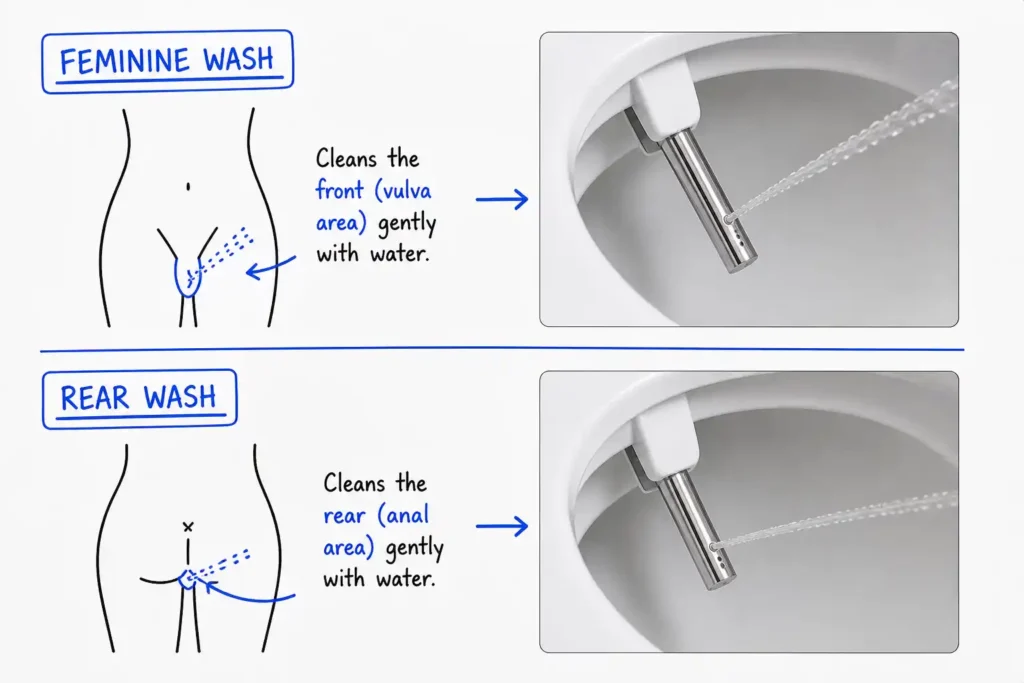
The feminine wash feature is the reason many women specifically seek out bidets over basic toilet paper alternatives. While all bidets can clean the rear area, the feminine wash is a function designed specifically for women — providing a separately positioned, gently angled stream of water targeted at the external genital area. Understanding how to use this feature correctly is what separates a good bidet experience from a great one for women. This section covers what the feminine wash setting actually is, the difference between single and dual-nozzle designs, how to activate it on different bidet types, the correct pressure and spray angle, and which bidets on the market offer the best feminine wash experience.
What Is The Feminine Wash Setting
The feminine wash setting — also commonly called the front wash or bidet feminine spray — is a dedicated function found on many modern bidets that provides a separate stream of water aimed specifically at a woman’s external genital area. Unlike the rear wash nozzle, which is positioned centrally and angled toward the anal area, the feminine wash nozzle is positioned further forward and angled upward at a gentler angle to comfortably reach the vulvar area without discomfort or excessive force.
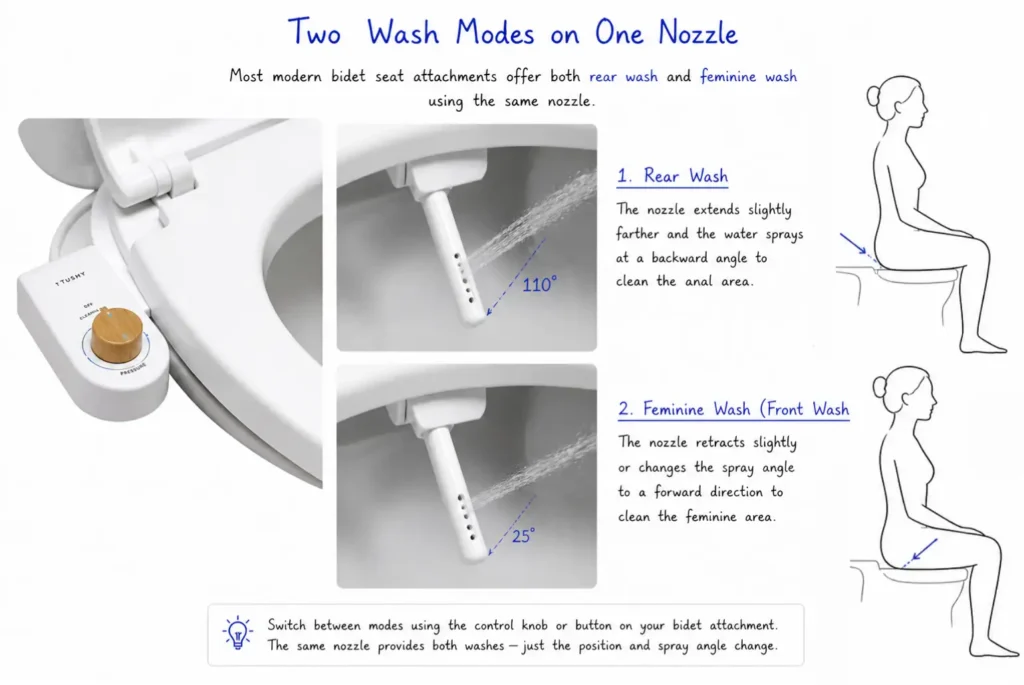
On electric bidet seats, this function is activated by a dedicated button on the control panel or remote, often labeled with a symbol of a woman’s silhouette, a front-facing nozzle icon, or simply the word “feminine.” The purpose of this feature is to allow women to maintain thorough external genital hygiene without the friction, chemical irritation, or incomplete cleaning associated with toilet paper and feminine wipes.
Single Nozzle Vs Dual Nozzle Bidet
When shopping for a bidet as a woman, the nozzle configuration is the most important hardware decision you will make. Single-nozzle bidets have one nozzle that handles both rear and feminine wash functions by adjusting its position — typically moving slightly forward for the front wash.
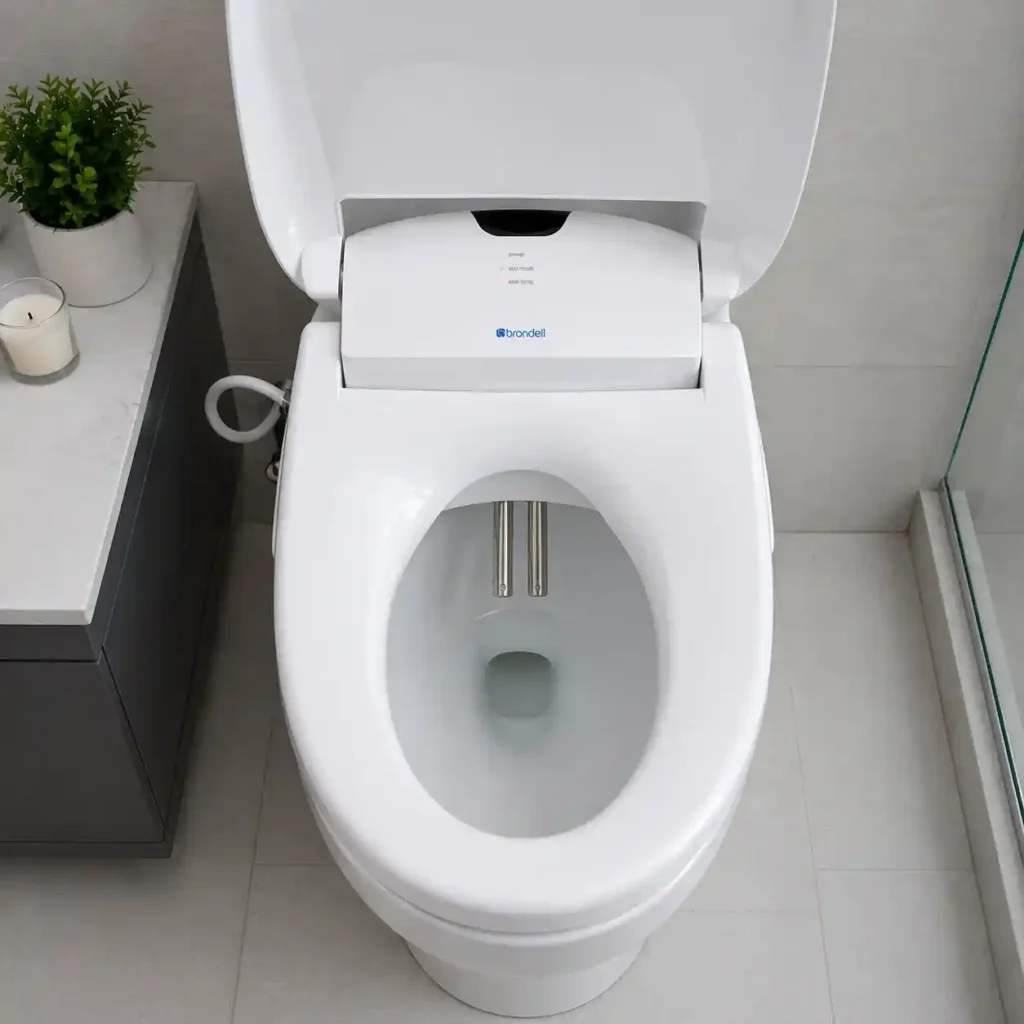
Dual-nozzle bidets have two completely separate nozzles: one fixed for rear cleaning, and one positioned further forward exclusively for feminine wash. The advantage of a dual-nozzle design is clear: each nozzle is optimized for its specific purpose, meaning the feminine wash nozzle is correctly positioned, correctly angled, and used exclusively for the front area — never sharing function with the rear nozzle. Single-nozzle designs can work adequately, but the nozzle position compromise means the front wash coverage may be less precise. For women who prioritize feminine hygiene, a dual-nozzle bidet is the strongly recommended choice.
How The Front Nozzle Is Positioned Differently
Understanding why the front nozzle is physically different from the rear nozzle will help you appreciate why bidet design matters for women. On a dual-nozzle bidet, the feminine wash nozzle is mounted approximately 1 to 2 inches further forward on the nozzle arm or wand compared to the rear nozzle. It is also angled at a shallower, more forward-facing angle rather than the steeper downward angle of the rear nozzle. This positioning ensures that when a woman sits in her natural toilet position, the front nozzle’s spray arc intersects with the external vaginal and labial area without requiring her to shift her position significantly. The spray pattern is also often wider and softer than the rear wash — designed for coverage of a more sensitive area rather than the targeted precision needed for rear cleansing. This deliberate engineering difference is what makes a quality feminine wash feel natural and comfortable rather than misdirected.
How To Activate Feminine Wash On An Electric Bidet
Activating the feminine wash on an electric bidet seat is straightforward once you know where to look. On models with a side control panel, look for a button labeled “front wash,” “feminine,” or represented by a woman’s silhouette icon. On models with a wireless remote control — common on higher-end Japanese-style bidet seats — the feminine wash button is usually clearly labeled and color-coded. When you press the button, the nozzle will extend automatically and begin spraying at a pre-set pressure and temperature. You can then adjust pressure using the dedicated pressure control buttons, and temperature using the temperature buttons. Many electric models also offer an oscillating mode where the nozzle moves gently back and forth for broader coverage. Always start at the lowest pressure setting before increasing, and use the nozzle position buttons to fine-tune the spray direction if needed.
How To Activate On A Non-Electric Bidet Attachment
Non-electric bidet attachments that include a feminine wash function are slightly different to operate. These models typically have two separate knobs or valves on the right side of the toilet — one for the rear wash and one for the feminine wash — or a single knob with a rotating selector that switches between the two nozzles. To activate the feminine wash, turn the dedicated feminine wash knob or selector slowly counterclockwise, starting with the gentlest possible water flow. Because non-electric attachments rely entirely on your home’s water pressure rather than an electric pump, the pressure can feel stronger than expected, making the slow-start approach especially important for the sensitive front area. Some non-electric attachments allow connection to both the cold and hot water supply lines for warm water delivery. If yours only connects to cold water, be prepared for the water temperature and adjust gradually.
Gentle Spray Angle For Front Wash
The correct spray angle for the feminine wash is forward-facing and upward-angled at approximately 30 to 45 degrees from horizontal — gentle enough to reach the external vaginal area without causing discomfort and without directing water internally.
If the spray angle feels too direct or too sharp, it is a sign that either the nozzle position needs adjusting or the pressure is too high. On electric bidets with adjustable nozzle positions, move the nozzle one or two clicks forward to bring the spray arc to a more comfortable position. The goal of the feminine wash spray angle is to create a soft, arcing stream of water that flows across the external labial and vaginal area and drains downward — not a straight-on high-pressure blast. Think of it as a gentle curved rinse, not a direct spray. If anything ever feels sharp, uncomfortable, or too forceful, reduce the pressure immediately.
Pressure Recommendation For Feminine Wash
The feminine wash should always be used at a lower pressure setting than the rear wash. The external genital area is significantly more sensitive than the perianal skin, and the tissue is more delicate and susceptible to irritation from excessive water force.
As a general guideline, use 30 to 50 percent of your maximum available pressure for the feminine wash. On most electric bidets with a five-level pressure scale, levels one or two are ideal for the front wash. On non-electric attachments, turn the knob to the point where water flows at a soft, steady stream rather than a pressurized jet. Over time, you will find your personal comfort level and develop a consistent setting. Never increase the feminine wash pressure in an attempt to feel “more clean” — higher pressure does not equal better cleaning, and it can cause irritation, tissue trauma, and disruption of natural vaginal moisture.
Oscillating Spray Vs Fixed Spray
Many electric bidet seats offer a choice between fixed spray and oscillating spray modes. Fixed spray delivers a steady, concentrated stream of water at one point — precise and efficient for targeted cleaning. Oscillating spray moves the nozzle gently back and forth in a small range, providing wider coverage over the cleaned area in a sweeping motion. For the feminine wash specifically, oscillating mode is often preferred by women because the broader coverage area means a more thorough rinse of the entire labial and vulvar region rather than a single focused point. Oscillating mode is also gentler in effect, as the water hits slightly different points across multiple passes rather than continuously hitting one sensitive spot at high intensity. If your bidet offers this feature, try it on the feminine wash setting — most women who discover it prefer it to fixed spray for front cleaning.
When To Use Feminine Wash Vs Rear Wash
Understanding when to use each setting is important for correct bidet hygiene. The rear wash should be used after every bowel movement — it is designed specifically for thorough anal cleaning. The feminine wash serves a different purpose and is used in different situations:
- After urination — a quick 15 to 20 second feminine wash rinse can keep the area fresh throughout the day, especially in warm climates or during physical activity.
- During menstruation — the feminine wash provides gentle, thorough rinsing that feels far more comfortable and effective than wiping during a heavy flow day.
- After sex — a gentle feminine wash rinse removes surface bacteria and body fluids from the external area.
- During pregnancy or postpartum recovery — when wiping is uncomfortable or difficult, the feminine wash provides hands-free hygiene.
Never use the rear wash nozzle to clean the front area. The two functions are not interchangeable and should always be used for their intended purpose.
Best Bidets With Feminine Wash Feature
If you are specifically looking for a bidet that delivers an excellent feminine wash experience, there are a few key features to prioritize. Look for dual-nozzle design, adjustable nozzle position, oscillating mode, warm water capability, and adjustable pressure control. Some of the most consistently well-reviewed models for feminine hygiene include the TUSHY Ace (electric seat with dedicated feminine wash), the BioBidet BLISS BB-2000 (dual nozzle, oscillating, warm water), the Brondell Swash 1400 (dual nozzle, adjustable warm water, air dryer), and for non-electric options, the TUSHY Classic 3.0 and BioBidet SlimEdge (affordable dual-nozzle attachments with feminine wash). Whichever model you choose, the presence of a dedicated, separately positioned feminine wash nozzle is non-negotiable for women who want the full hygiene benefit a bidet can offer. You can compare top-rated options at Consumer Reports.Query 6 in full.
Recommended Reading: Bio Bidet BB-2000 Bliss Review: Is This the Best Luxury Bidet Seat Under $600?
Recommended Reading: Brondell Swash 1400 Review: The Best Value Luxury Bidet Seat You Can Actually Live With (2026)
Can Bidets Cause UTI In Women
Urinary tract infections are one of the most common health concerns for women worldwide, and it is completely understandable that many women want to know whether switching to a bidet could increase their risk. The honest answer is nuanced: a bidet used correctly significantly reduces the risk of UTIs, while a bidet used incorrectly can increase that risk. The difference comes down almost entirely to technique, water direction, nozzle cleanliness, and water quality. This section examines why women are more vulnerable to UTIs than men, how improper bidet use can contribute to infection, and — most importantly — how correct bidet use can actually become one of the most effective daily habits a woman can adopt to protect her urinary tract health. Every sub-topic here is medically grounded and practically actionable.
Why Women Are More Prone To UTIs
To understand the relationship between bidets and UTIs, it helps to first understand why women are so much more vulnerable to urinary tract infections than men. Women have a urethra that is approximately 4 centimeters long, compared to approximately 20 centimeters in men. This shorter urethra means bacteria have a much shorter distance to travel to reach the bladder and cause infection. Additionally, the female urethra is located in very close anatomical proximity to both the vaginal opening and the anus — the two primary sources of bacteria that cause UTIs. The most common UTI-causing bacterium is E. coli, which originates in the gut and is present in the anal region. Any hygiene practice — including wiping, washing, or spraying — that moves bacteria from the anal area toward the urethra creates infection risk. According to the National Institute of Diabetes and Digestive and Kidney Diseases (NIDDK), approximately 60 percent of women will experience at least one UTI in their lifetime, making this a genuinely critical hygiene consideration.
How Back-To-Front Spraying Causes UTI
The most direct way a bidet can cause a UTI in women is through back-to-front water direction — spraying from the anal area toward the urethral opening rather than in the correct front-to-back direction. When water is directed from the rear toward the front, it can carry fecal bacteria — particularly E. coli — directly toward the urethra and vaginal opening, creating ideal conditions for a urinary tract infection to develop. This is the primary mechanism by which incorrect bidet use leads to UTIs, and it is entirely preventable. On standalone bidets and handheld sprayers, the user controls the water direction entirely, which is where the risk is highest if technique is not understood. On bidet seats and attachments with a dedicated feminine wash nozzle, the nozzle is already positioned at the front and sprays in the correct direction by design — making front-to-back direction automatic, provided you use the correct wash setting.
Correct Front-To-Back Direction To Prevent UTI
Preventing bidet-related UTIs comes down to one consistent, non-negotiable rule: always spray and rinse from the front of your body toward the back, never in reverse. In practical terms, this means when you activate the feminine wash, the water should flow across the vulvar area and drain toward — not away from — the anus. When transitioning from front to rear cleaning, always finish the front wash first before activating the rear wash. Never use the rear nozzle for front cleaning, as this transfers bacteria from the rear nozzle position toward the front area even if the water direction seems neutral. On a handheld bidet sprayer, hold the nozzle at the front of your body and angle the spray so water flows backward. A useful mental reference: imagine the water flowing in exactly the direction you would wipe with toilet paper — always from urethra to anus, never the other way.
Role Of Water Quality In UTI Risk
An often-overlooked factor in bidet-related UTI risk is the quality of the water supply itself. In the United States, Canada, the UK, Australia, and most of Western Europe, household tap water meets strict safety standards and is entirely safe for external bidet use. However, in regions where water quality is inconsistent, contaminated tap water could theoretically introduce bacteria to the genital area during bidet use. Even in high-quality water supply regions, bidet water lines that have not been properly maintained can develop bacterial buildup inside the supply hose or nozzle, particularly in the form of biofilm — a thin bacterial coating that forms on the interior of water pipes and fixtures over time. To minimize this risk, flush your bidet nozzle for a few seconds before your first use of the day, keep the nozzle clean, and if your bidet has been unused for several days, run water through it before using. In areas with known water quality concerns, consider a bidet with a built-in water filtration feature.
Warm Water Bidets And Vaginal Flora Disruption
Research from Japan and South Korea has identified a specific concern about warm water bidet use and its effect on the vaginal microbiome. The vagina maintains a naturally acidic pH environment populated by beneficial lactobacillus bacteria that protect against infections including UTIs, bacterial vaginosis, and yeast infections. Some studies have found that women who regularly use warm water bidets directed at the front area show decreased lactobacillus counts and increased fecal bacterial presence in vaginal microflora samples compared to non-bidet users. The theory is that warm water may be more effective at temporarily displacing the natural bacterial coating of the vaginal vestibule. It is important to note that these findings come from a limited number of studies, primarily in Asian populations, and have not been broadly replicated. The practical takeaway is simple: use cooler or room-temperature water for the feminine wash and reserve warmer temperatures for the rear wash. This precaution costs you nothing and eliminates the theoretical microflora risk entirely.
Dirty Nozzle As A UTI Risk Factor
A bidet nozzle that is not cleaned regularly can itself become a reservoir of bacteria — including the very bacteria you are trying to wash away. Over time, mineral deposits from hard water, residual moisture, and organic matter can accumulate on and around the nozzle tip, creating an environment where bacteria can multiply. If this contaminated nozzle then sprays water near the urethral opening, the risk of bacterial introduction is real. This is why nozzle hygiene is not optional — it is a core part of safe bidet use for women. Clean the nozzle manually at least once per week using a mild bathroom cleaner or diluted white vinegar solution. If your bidet seat has a self-cleaning nozzle function, activate it before each use as an additional layer of protection. Replace bidet attachments every one to two years if you notice discoloration, mineral buildup, or any deterioration of the nozzle material that cannot be cleaned away.
Bidet Use After Sex And UTI Prevention
Post-sex UTIs are extremely common in women — so common that the medical community uses the term “honeymoon cystitis” to describe the pattern of UTIs that develop after sexual intercourse. During sex, bacteria from the perianal area and from a partner’s body can be introduced to the urethral opening, and the physical pressure of intercourse can push these bacteria toward the bladder. Using a bidet immediately after sex is one of the most effective simple steps a woman can take to reduce post-coital UTI risk. A gentle feminine wash rinse after intercourse removes surface bacteria from the urethral and vaginal area before they have a chance to migrate inward. Urinating after sex is also strongly recommended by urologists as a complementary step — it flushes the urethra from the inside while the bidet cleans the outside. Together, post-sex urination and a gentle bidet rinse form a highly effective UTI prevention routine. Learn more about UTI prevention strategies at Mayo Clinic.
Signs You Have A UTI
Knowing the symptoms of a UTI is important, because if you develop one despite correct bidet use, early identification and treatment prevents the infection from progressing to the kidneys. The classic signs of a urinary tract infection in women include:
- A burning or stinging sensation during urination — the most commonly reported symptom.
- Frequent, urgent need to urinate with very little urine produced each time.
- Cloudy, dark, or strong-smelling urine that differs from your normal appearance.
- Pelvic pressure or discomfort, particularly in the lower abdomen and pubic area.
- Blood in the urine (hematuria) — this indicates a more developed infection requiring prompt medical attention.
- Fever, chills, back pain, or nausea — these are signs the infection may have reached the kidneys and require immediate medical care.
If you experience any of these symptoms, see a healthcare provider promptly. UTIs are treated with antibiotics and resolve quickly when caught early, but untreated UTIs can progress to kidney infections that require hospitalization.
How Bidets Can Actually Prevent UTIs
While this section has covered the risks of incorrect bidet use, it is equally important to emphasize that correct bidet use is genuinely protective against UTIs. The core mechanism is straightforward: thorough water cleaning of the perianal and urethral area after every toilet use removes fecal bacteria from the skin surface before it has any opportunity to migrate toward the urethra. Toilet paper, by contrast, wipes but does not fully remove bacteria — studies have consistently shown that toilet paper leaves significant bacterial residue on the perianal and vulvar skin even after multiple wipes. Additionally, the physical friction of wiping can cause micro-abrasions in delicate urethral tissue, creating entry points for bacteria. A gentle bidet rinse removes bacteria without friction, without residue, and without irritation. Women who use bidets correctly and consistently report significantly fewer UTI episodes — a pattern supported by the clinical recommendation of bidets by urologists and gynecologists for UTI-prone women.
When To See A Doctor
If you develop a UTI, it is important to seek medical treatment rather than attempting to self-treat with home remedies alone. See a doctor promptly if you experience burning urination, frequent urging, cloudy urine, or pelvic discomfort. If symptoms include fever, back pain, nausea, or vomiting, seek medical care immediately as these suggest the infection has reached the upper urinary tract or kidneys. Women who experience three or more UTIs per year should discuss recurrent UTI prevention strategies with a urologist or gynecologist — including an evaluation of their hygiene practices, bidet technique, sexual health habits, and whether low-dose prophylactic antibiotics or other preventive measures are appropriate. It is also worth noting that bidet use alone cannot cure an active UTI — once infection is established, antibiotic treatment is required. The bidet’s role is prevention, not treatment. Always follow your doctor’s guidance and complete any prescribed antibiotic course in full.
How To Use A Bidet During Your Period
Menstruation is one of the situations where a bidet transitions from a convenient hygiene tool to an genuinely life-changing one for women. The combination of blood, discharge, sensitivity, and the need for frequent hygiene throughout the day makes the menstrual cycle one of the most demanding periods for feminine hygiene management. Toilet paper is abrasive, wet wipes are filled with chemicals that irritate already-sensitive tissue, and neither provides the thorough, fresh cleaning that water delivers effortlessly. Using a bidet during your period gives you a clean, chemical-free, gentle rinse whenever you need it — whether you are at home changing a pad, adjusting a tampon, or simply freshening up throughout the day. This section covers exactly how to use your bidet during menstruation, what settings to use, how it interacts with different menstrual products, and why it is a genuinely superior approach to period hygiene.
Why Toilet Paper Is Harsh During Menstruation
During menstruation, the vulvar and labial tissue becomes more sensitive due to hormonal changes, increased blood flow to the pelvic region, and the physical presence of menstrual fluid on the skin surface. Toilet paper — particularly the standard multi-ply varieties most widely used in the USA, UK, and Canada — contains bleaching agents, dyes, and wood fiber residue that can cause micro-irritation on normal skin. During a period, when skin is already more sensitive and the tissue is in contact with blood for extended periods, this irritation is significantly amplified. Many women experience increased redness, soreness, or itching during their period that is directly caused or worsened by repetitive wiping with dry toilet paper rather than by the menstrual cycle itself. Replacing toilet paper wipes with a gentle bidet rinse during your period eliminates this friction entirely, removing menstrual blood and discharge with clean water and no surface abrasion.
Rinsing Technique During Heavy Flow Days
On heavy flow days, the bidet becomes particularly valuable because it can quickly and thoroughly rinse away blood and discharge that toilet paper would require multiple wipes to address — and even then, incompletely. The correct technique for rinsing during a heavy flow day is to use the feminine wash setting at low to medium pressure, allowing the water to flow gently across the external vulvar area for 20 to 40 seconds. The water will naturally carry menstrual blood away and drain into the toilet below. You do not need to apply any soap, body wash, or cleaning product to the bidet stream — water alone is sufficient and safer for the vaginal area, as soaps can disrupt natural pH. After rinsing, gently pat the area dry with toilet paper or a soft cloth before replacing your menstrual product. The entire process takes under a minute and leaves you feeling genuinely clean rather than just wiped.
Using Warm Water For Menstrual Cramp Relief
One of the less obvious but highly appreciated benefits of using an electric bidet during menstruation is the soothing effect of warm water on menstrual cramps and pelvic discomfort. The perineal and lower pelvic region contains dense nerve and muscle tissue that responds to temperature — the same principle behind warm heating pads and hot water bottles being effective for period pain. A warm water bidet rinse directed at the perineal area can provide temporary but genuine relief from cramping and pelvic tension, particularly during the first two days of a heavy cycle when pain is typically at its peak. This benefit is exclusive to electric bidets with warm water capability. Set the water temperature to a comfortably warm — not hot — level when using it for cramp relief. The effect is comparable to a localized warm compress applied directly to the area, offering a natural, medication-free moment of comfort during an often physically challenging time.
How Often To Use Bidet During Period
During your period, you can use the bidet as frequently as you need to feel clean and comfortable — there is no limit to safe usage frequency. Most women find it most useful at the following times: every time they change a pad, tampon, or menstrual cup; after using the toilet during the day; and before bed as part of their evening hygiene routine. On heavy flow days, this may mean four to six bidet rinses throughout the day, which is entirely safe and beneficial. On lighter days toward the end of the cycle, once or twice may be sufficient. The key is that each rinse should be brief — 20 to 30 seconds is enough — and always uses the feminine wash setting at gentle pressure. There is no advantage to longer or more forceful spraying, and excessive pressure on already-sensitive menstrual tissue can cause discomfort. Use the bidet whenever you feel the need to freshen up, and trust the sensation of clean water to guide you.
Bidet Use With A Tampon In
Yes, you can use a bidet while wearing a tampon, and doing so is completely safe. The bidet cleans only the external genital area — the vulva, labia, and perineal skin — and does not affect the tampon positioned internally in the vaginal canal. The gentle stream of water from the feminine wash setting does not have the pressure or angle to push water internally past the vaginal opening or displace a correctly inserted tampon. The tampon string may get wet during a bidet rinse, which is normal and harmless — simply pat it gently dry along with the surrounding area after your rinse. If you find the wet string uncomfortable, you can tuck it slightly to one side during the rinse, though this is not necessary for hygiene purposes. Using a bidet with a tampon in is one of the most practical period hygiene combinations available, allowing you to maintain external cleanliness throughout the day without needing to remove and replace your tampon each time.
Bidet Use With A Menstrual Cup
Using a bidet while wearing a menstrual cup is equally safe and follows the same principle as tampon use — the bidet washes only the external area and does not interfere with the cup positioned internally. However, there is one specific situation during the menstrual cup routine where the bidet is particularly useful: when removing, emptying, and reinserting your menstrual cup. After removing and emptying the cup, before reinserting it, a gentle bidet rinse of the external vaginal area removes any blood residue from the labia and vulvar skin, providing a clean environment for reinsertion. Many menstrual cup users also use the bidet after reinsertion to clean their hands and the external area simultaneously — though washing hands with soap and water at the sink remains the primary hand hygiene step. The bidet enhances the cup-changing process by adding an effortless external cleaning step that tissue paper alone cannot match.
Replacing Period Wipes With A Bidet
Feminine period wipes are one of the most chemically problematic hygiene products marketed to women, and the bidet is their far superior replacement. Period wipes — including those marketed specifically for menstrual use — typically contain preservatives such as methylisothiazolinone, fragrances, propylene glycol, and surfactants that are known irritants and potential endocrine disruptors. The Environmental Working Group (EWG) consistently rates many feminine wipe products poorly for ingredient safety. During menstruation, when skin is already sensitized, these chemicals are absorbed more readily and can disrupt vaginal pH, trigger yeast overgrowth, and cause contact dermatitis. A bidet delivers the same — actually superior — level of cleanliness using nothing but clean water, with zero chemicals, zero waste, and zero cost per use after the initial purchase. Women who replace period wipes with a bidet consistently report less irritation, less odor, and greater comfort throughout their cycle.
Reducing Odor During Menstruation
Menstrual odor is a source of significant self-consciousness for many women, and it is one of the most common reasons women reach for scented period products — which, ironically, often make the problem worse. Menstrual odor is caused by the oxidation of menstrual blood on the skin surface and the interaction of blood with naturally occurring skin bacteria. It has nothing to do with internal vaginal odor, which is normal and healthy. The most effective way to reduce menstrual odor is to remove blood from the skin surface promptly and thoroughly — which is precisely what a bidet does better than any wipe or paper product. A bidet rinse after each pad change or toilet visit removes the blood-bacteria interaction that causes odor at its source, leaving the external area genuinely clean rather than masked by fragrance. No scented product is needed. Clean water is the most effective and safest odor management tool available for menstrual hygiene.
Pressure Setting During Sensitive Period Days
During menstruation — especially during the first two days of a heavy cycle — the external genital tissue is at its most sensitive. Using the correct pressure setting during this time is more important than at any other point in the month. The recommended setting for period use is the lowest or second-lowest pressure level available on your bidet. This provides sufficient water flow to clean effectively without adding any physical pressure to already-sensitized tissue. If you are using a non-electric bidet attachment with manual pressure control, turn the valve very slowly until water flows at a soft, gentle stream — barely more than a trickle is genuinely sufficient for menstrual rinsing. Increasing pressure does not improve cleanliness during your period — it only increases the risk of discomfort and irritation. As your flow lightens toward the end of your cycle and sensitivity decreases, you can return to your normal preferred pressure setting.
Bidet Vs Feminine Hygiene Wipes During Period
The comparison between bidet and feminine hygiene wipes during menstruation is overwhelmingly in the bidet’s favor across every relevant category:
- Cleanliness: A bidet uses flowing clean water to physically wash away blood and bacteria. Wipes spread residue across the skin surface rather than removing it.
- Skin safety: Water has no chemical ingredients. Wipes contain preservatives, fragrances, and surfactants that disrupt vaginal pH and can cause irritation.
- Odor control: The bidet removes the odor source. Wipes mask odor with fragrance while leaving bacteria on the skin.
- Cost: After the initial bidet purchase, each use costs effectively nothing. Wipes are an ongoing monthly expense averaging $10 to $20 or more per cycle.
- Environmental impact: A bidet produces zero waste. Feminine wipes are single-use plastic-containing products that clog sewers and fill landfills.
- Medical recommendation: Gynecologists recommend avoiding scented and chemical products near the vaginal area. A bidet satisfies this guidance completely.
For women who currently rely on feminine hygiene wipes during their period, switching to a bidet is one of the most impactful personal hygiene upgrades they can make — for their health, their wallet, and the environment.
How To Use A Bidet Postpartum After Giving Birth
The postpartum period is one of the most physically demanding times in a woman’s life, and personal hygiene during recovery presents real challenges that most people do not discuss openly enough. Whether you have had a vaginal delivery or a cesarean section, the weeks following childbirth involve significant tissue sensitivity, wound healing, and hygiene needs that standard toilet paper is genuinely ill-equipped to handle. Wiping with dry paper after a vaginal delivery — particularly if you have perineal stitches, tears, or an episiotomy — can be painful to the point of being unbearable for many women. The bidet offers something no other bathroom tool can match in this context: a completely hands-free, no-contact, gentle water rinse that cleans the perineal area thoroughly without touching, stretching, or disturbing healing tissue in any way. This section covers every aspect of postpartum bidet use, from the first hours after birth through full recovery.
Why Wiping Is Painful After Vaginal Delivery
To understand why a bidet is so valuable postpartum, it helps to understand exactly what the perineal region goes through during a vaginal delivery. The perineum — the tissue between the vaginal opening and the anus — stretches enormously during childbirth and frequently sustains tears of varying degrees, or is deliberately cut in a procedure called an episiotomy. First and second-degree tears involve skin and superficial muscle tissue. Third and fourth-degree tears extend deeper into the anal sphincter and rectal tissue. All of these injuries require stitches, leave raw, swollen, bruised tissue, and make the simple act of touching or wiping that area after using the toilet an experience many postpartum women describe as one of the most painful parts of early recovery. Dry toilet paper dragged across suture lines, swollen labia, and broken skin is not just uncomfortable — it can disturb stitches, introduce bacteria to open wounds, and significantly slow the healing process.
Bidet As A Replacement For The Peri Bottle
Most women who deliver in hospitals in the United States are sent home with a peri bottle — a simple plastic squeeze bottle that you fill with warm water and manually squirt over the perineal area after using the toilet.
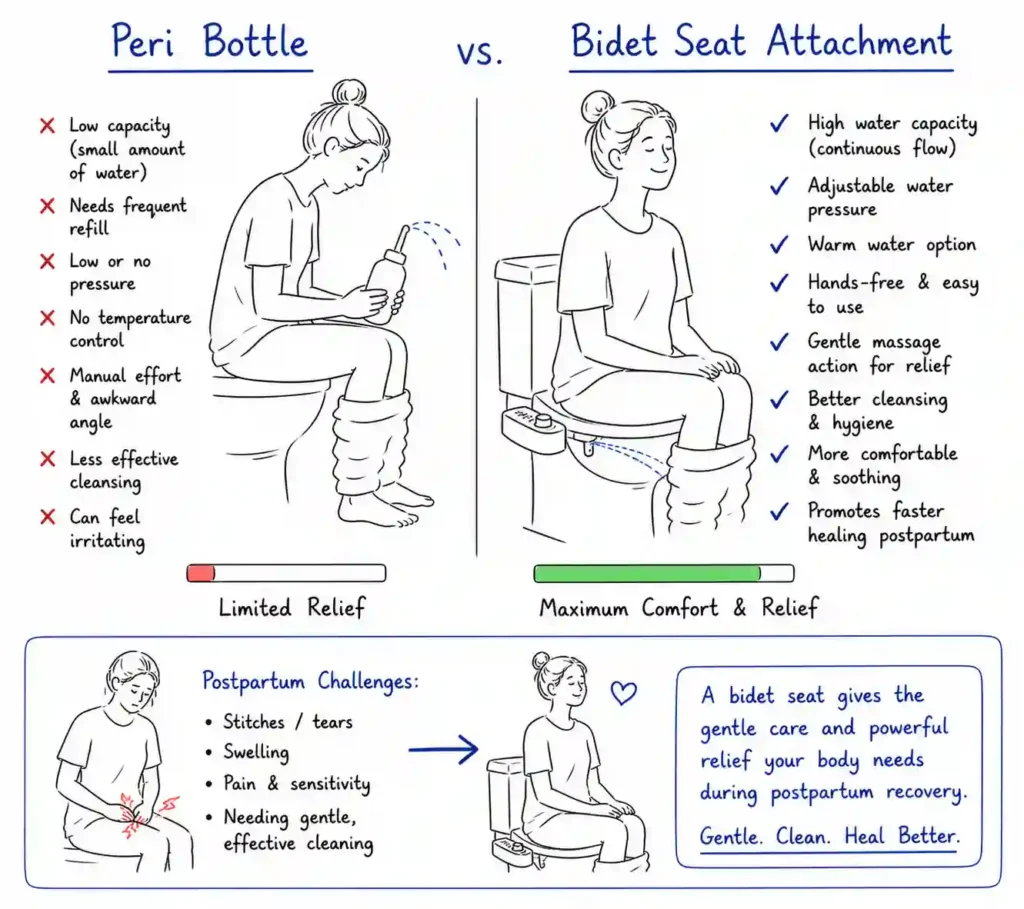
The peri bottle is a genuine improvement over toilet paper for postpartum hygiene, but it has significant limitations. It requires you to fill it, hold it, aim it, and squeeze it — all while managing the physical challenges of sitting down and standing up in the early postpartum days. A bidet replaces the peri bottle entirely and does every one of these functions automatically, hands-free, and more effectively. The bidet delivers a consistent, controlled stream of water at your chosen pressure and temperature without requiring any manual effort. For women recovering from perineal tears, C-sections, or extreme fatigue in the early postpartum days, this difference is not trivial — it is genuinely significant for both comfort and recovery.
Bidet Vs Sitz Bath Postpartum
A sitz bath is another commonly recommended postpartum hygiene and recovery tool — a shallow basin that sits over the toilet bowl and is filled with warm water, allowing the perineal area to soak for 15 to 20 minutes. Sitz baths are effective for reducing swelling, soothing pain, and promoting healing in the perineal region, and many OB/GYNs recommend them in the first weeks after delivery.
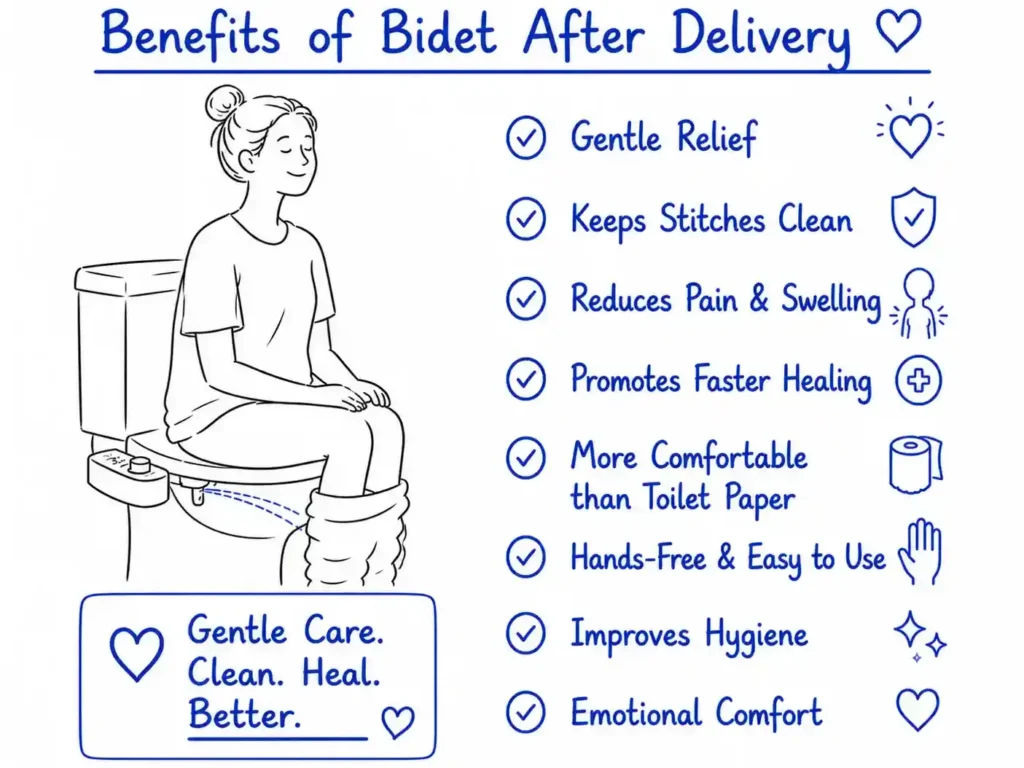
The bidet does not fully replace the therapeutic sitz bath — particularly in the first few days when swelling and pain relief are primary goals — but it does replace it for the routine daily hygiene function. Rather than setting up a sitz bath every time you use the toilet, a bidet provides instant, no-setup hygiene after each visit, reserving the sitz bath for dedicated pain and swelling management sessions. Many postpartum women use both: the bidet for routine toilet hygiene throughout the day, and the sitz bath once or twice daily for therapeutic recovery purposes. Learn more about postpartum perineal care at the American College of Obstetricians and Gynecologists (ACOG).
Safe Water Pressure For Perineal Healing
Water pressure management is the most critical technical consideration for postpartum bidet use, and getting it wrong can genuinely impede healing. In the first days and weeks after delivery, the perineal tissue is raw, swollen, sutured, and in an active healing state.
Any water pressure beyond the absolute gentlest setting can cause pain, disturb sutures, or displace healing tissue. Always use the lowest pressure setting available on your bidet during the postpartum period — on an electric bidet seat, this is level one of five. On a non-electric attachment, turn the valve so slowly that the water barely flows, producing a soft trickle rather than a directed stream. As healing progresses over the following weeks and sensitivity decreases, you can very gradually increase to a slightly higher pressure. A general guideline from postpartum care nurses is to use pressure no stronger than what you would feel from water poured slowly from a cup — gentle, gravity-like flow rather than any form of pressurized spray.
C-Section Recovery And Bidet Use
While much of the postpartum bidet discussion focuses on vaginal delivery recovery, women recovering from cesarean sections also benefit significantly from bidet use, for different but equally valid reasons. A C-section is major abdominal surgery involving an incision through multiple layers of tissue, and recovery involves significant core weakness, reduced mobility, and restricted bending and reaching for weeks afterward. Reaching back to wipe with toilet paper after a C-section requires the exact twisting, stretching, and abdominal engagement that post-surgical guidelines specifically prohibit in the early recovery period. A bidet eliminates the need to reach, twist, or strain entirely — you remain seated upright, activate the bidet, and the cleaning is done without any physical exertion. Additionally, many women after C-sections experience constipation from pain medication and reduced mobility, making bowel movements uncomfortable. The bidet’s gentle rear wash provides significantly more comfortable cleaning during this time than toilet paper.
Stitches And Bidet Safety
One of the most common questions postpartum women have is whether using a bidet is safe when they have perineal stitches or sutures. The answer, supported by midwives and OB/GYNs consistently, is yes — when used at the correct (very low) pressure. Modern obstetric sutures are designed to withstand the normal physical challenges of early postpartum life, including urination, bowel movements, and gentle washing. A soft, low-pressure stream of water directed at the sutured area does not have the force to displace, dissolve, or damage correctly placed stitches. What it does do is gently clean bacteria, blood, lochia (postpartum discharge), and urine from around the wound without the mechanical friction of wiping, which is the most dangerous action for healing stitches. If you are ever uncertain about whether your specific type of sutures or wound condition is compatible with bidet use, ask your midwife or OB/GYN at your first postpartum check — in virtually all cases, they will confirm that gentle bidet rinsing is not only safe but actively recommended.
How Soon After Birth Can You Use A Bidet
You can begin using a bidet immediately after giving birth — in fact, the first toilet visit after delivery is precisely when a bidet is most valuable. Most postpartum women are asked by nursing staff to urinate within six hours of delivery, and this first urination over healing perineal tissue is notoriously uncomfortable. A bidet running during urination dramatically reduces the burning sensation by diluting urine with water as it passes over broken skin. Many labor and delivery units in progressive hospitals now have bidet toilet seats installed specifically for this purpose. If you are giving birth at home or in a birth center, having a bidet attachment already installed before your due date means you are prepared from the very first postpartum bathroom visit. There is no recovery milestone you need to reach before beginning bidet use — low-pressure water cleaning is safe, gentle, and beneficial from the very first use.
Warm Water For Postpartum Hemorrhoid Relief
Hemorrhoids — swollen, inflamed veins in the rectal and anal area — affect a very high percentage of women during pregnancy and the immediate postpartum period. The combination of prolonged pushing during labor, increased pelvic blood pressure during pregnancy, and constipation from pain medications creates ideal conditions for hemorrhoid development. Warm water from a bidet provides genuine, immediate relief for postpartum hemorrhoids through two mechanisms: first, the warmth promotes blood vessel relaxation and reduces swelling; second, the gentle water cleansing removes irritants from the anal skin surface without the abrasive friction of toilet paper, which is one of the primary drivers of hemorrhoid pain and bleeding. Set your bidet to a comfortably warm temperature — not hot — and use the rear wash at very low pressure to clean and soothe the anal area after each bowel movement. Most women report noticeable relief within seconds of the warm water making contact with inflamed hemorrhoidal tissue.
Preventing Postpartum Infection With A Bidet
The postpartum period carries a significant risk of perineal and uterine infection — conditions collectively referred to as postpartum infections or puerperal sepsis in their most serious forms. The perineum, with its open wounds, stitches, and continuous exposure to lochia, blood, urine, and stool, is highly vulnerable to bacterial infection in the days and weeks after delivery. Thorough, gentle hygiene after every toilet visit is one of the most important infection prevention measures a postpartum woman can take, and a bidet makes this dramatically easier and more effective than toilet paper. By removing bacteria, blood, and discharge from the wound surface with clean water after every use, the bidet reduces the bacterial load around healing tissue and lowers the risk of wound contamination. Healthcare providers consistently recommend keeping the perineal area clean and dry, and a bidet — followed by gentle pat-drying — is the most effective way to achieve both. If you notice increasing redness, swelling, unusual odor, or fever after delivery, contact your healthcare provider immediately as these may indicate infection.
OB/GYN Recommendations On Postpartum Bidet Use
The medical community’s support for postpartum bidet use is strong and consistent. OB/GYNs, midwives, and postpartum nurses across the United States, UK, Canada, and Australia increasingly recommend bidet use as a standard part of postpartum perineal care, particularly as bidets become more mainstream and affordable in these markets. The key medical recommendations for postpartum bidet use are: use the lowest pressure setting available, use warm but not hot water, clean from front to back, pat dry gently rather than rubbing, and keep the bidet nozzle itself clean to prevent it becoming a bacterial source. The official guidance from ACOG supports gentle water washing of the perineum postpartum and recommends avoiding harsh soaps, scented products, and abrasive wiping — all of which a bidet naturally avoids. For women who had significant perineal tearing or surgical repair, always confirm specific care instructions with your individual care provider, as complex wound cases may have additional considerations beyond standard bidet use.
How To Sit On A Bidet Correctly As A Woman
Correct positioning on a bidet is something that most first-time users figure out through trial and error, but knowing the right technique before you start saves you frustration, ensures effective cleaning, and prevents the common problem of the water missing its target entirely. The way you sit on a bidet varies depending on which type of bidet you are using — a bidet seat attachment, a standalone freestanding bidet, or a handheld sprayer each require slightly different positioning approaches. For women specifically, correct positioning matters even more than for men because there are two distinct cleaning zones — front and rear — that require different spray angles, and achieving good coverage for both without shifting dramatically requires understanding a few simple techniques. This section covers every positioning scenario a woman might encounter.
Sitting On A Bidet Seat Attachment (Face Forward)
The most common bidet setup in the United States, Canada, and the UK is the bidet seat or bidet attachment fitted directly to a standard toilet. For this type of bidet, positioning could not be simpler: sit exactly as you would normally sit on your toilet, facing forward toward the wall.
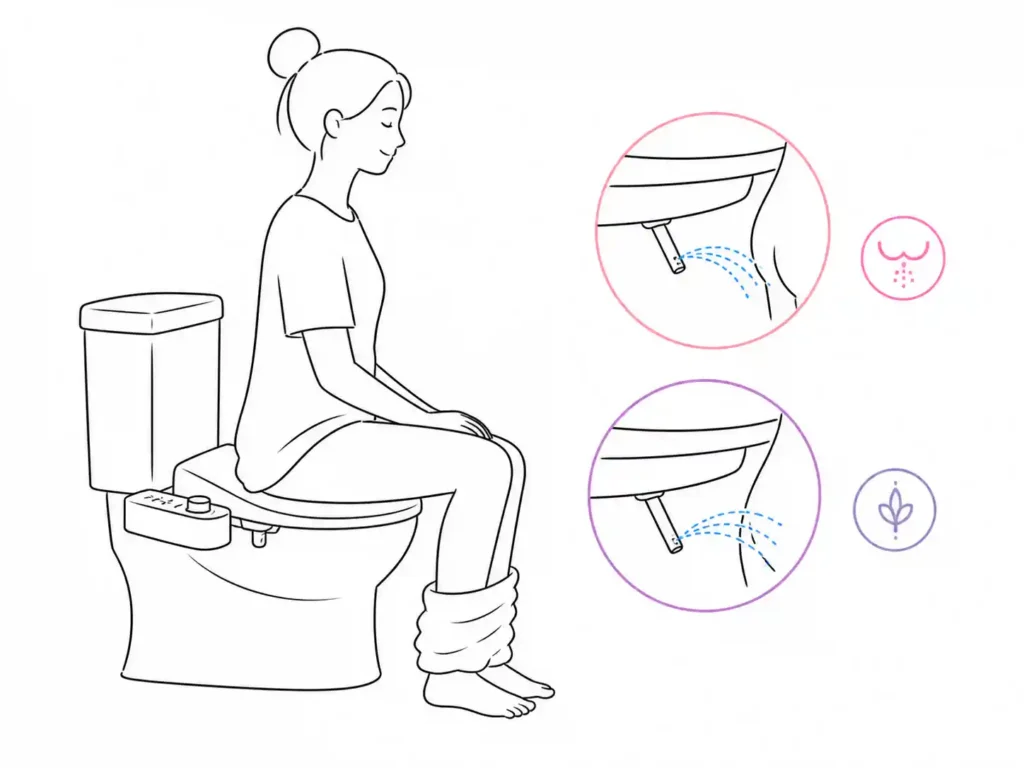
There is no need to straddle, reverse, or shift significantly from your normal toilet-sitting position. The bidet nozzle is built into the seat unit beneath you, positioned to spray upward from behind and below. When you activate the rear wash, the spray reaches the anal area automatically from this standard seated position. When you activate the feminine wash, the forward nozzle reaches the front genital area from the same seated position. The entire design of a bidet seat and attachment is built around a woman’s normal forward-facing seated posture, making it the most user-friendly bidet option available.
Many people are confused about this: You do not need to turn around or reposition yourself for a front feminine wash. The bidet nozzle is designed to handle both — it simply adjusts its angle or water pressure direction to reach the front area after a rear wash. No awkward repositioning required.
Sitting On A Standalone/Freestanding Bidet
A standalone or freestanding bidet is a separate porcelain fixture positioned next to the toilet, common in European, South American, and many hotel bathrooms. Using this type requires an additional step — you must finish using the toilet, stand up, adjust your clothing, and then move to and sit on the separate bidet fixture. The standalone bidet resembles a low, elongated basin with a faucet at one end and drain at the center. There are two approaches to sitting on a standalone bidet, and both are correct — the right choice depends on what you need to clean. Facing the faucet end allows easier access to front-facing controls and a more natural angle for feminine wash. Facing away from the faucet directs water more naturally toward the rear area. Neither position is universally correct — use whichever gives you the best water coverage for the area you are cleaning.
Facing Forward Vs Facing Backward On Standalone
This is one of the most genuinely confusing aspects of standalone bidet use for first-time users, and it deserves a clear, direct answer. Facing forward (toward the faucet) on a standalone bidet gives you easy access to the water controls with your hands, allows the water jet to flow more naturally toward the front genital area, and is the position most commonly preferred by women for feminine wash.
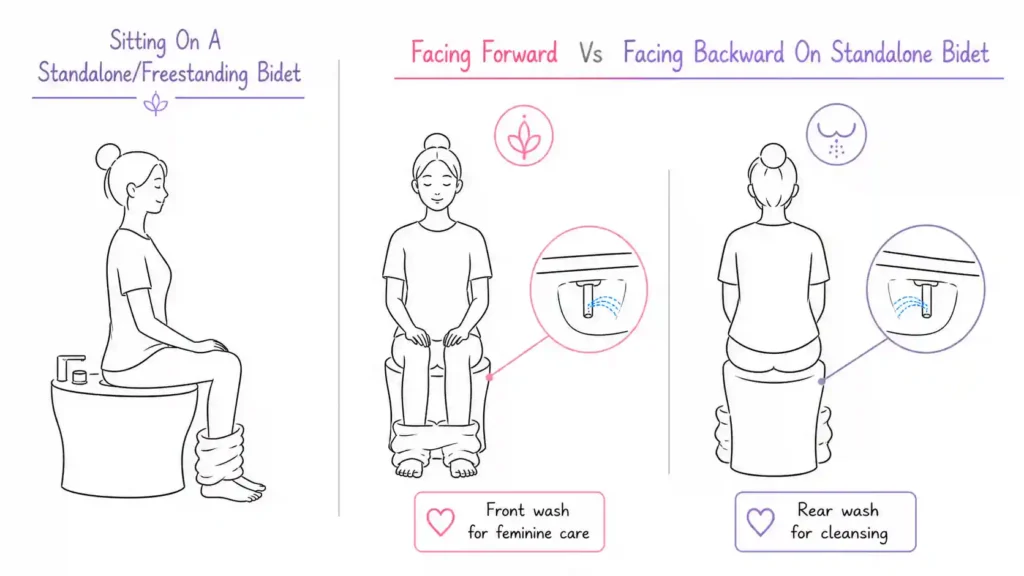


Facing backward (away from the faucet) positions the water jet to spray more effectively toward the anal and rear perineal area, making it the natural choice for rear cleaning after a bowel movement. Some women find it most practical to start facing forward for front cleaning, then turn around for rear cleaning. Others find a single position with slight body adjustment sufficient for both. There is no single universally correct answer — experiment with both positions and choose based on which provides the most comfortable and effective coverage for each cleaning need.
Straddling Technique
The straddling technique is an alternative sitting approach used on standalone bidets that some women find more comfortable and practical than the forward or backward sitting positions. To straddle the bidet, you position yourself with one leg on each side of the fixture, facing whichever direction is most comfortable, and lower yourself onto the basin in a position similar to sitting astride a horse. This gives you a wider, more stable base and allows your body to be centered over the water jets, which are typically positioned in the center of the basin. The straddling position provides particularly good access for rear cleaning while also allowing forward lean for front cleaning without changing positions. For women with limited hip flexibility or those who find the traditional seated bidet position awkward, straddling is a practical and effective alternative. Your clothing should be removed from at least one leg before straddling to allow full freedom of movement.
Leaning Forward For Front Wash
Whether you are using a bidet seat, attachment, or standalone bidet, a slight forward lean from your normal seated position helps direct the water spray more accurately toward the front genital area during feminine wash. On a bidet seat or attachment, where the nozzle position is fixed, leaning forward by approximately 10 to 15 degrees from vertical shifts the target zone of the spray arc forward — bringing it into better alignment with the vulvar area. This is a subtle movement, not a dramatic posture change. Think of it as a gentle tilt rather than a full lean. On a standalone bidet facing the faucet, leaning slightly forward over the basin similarly brings the front area into better contact with the upward water jet. Many women combine the forward lean with the previously mentioned bidet shimmy — a small forward tilt plus a slight rocking motion — to achieve ideal front wash coverage without needing to adjust nozzle settings.
Leaning Back For Rear Wash
Conversely, a slight backward lean from your normal seated position improves coverage and effectiveness of the rear wash. On a bidet seat or attachment, leaning back very slightly — again, 10 to 15 degrees — shifts the target zone of the rear nozzle’s spray arc toward the anal area, ensuring the water hits directly rather than landing on the lower buttocks. This adjustment is particularly helpful for women with a fuller body shape, where the natural seated position may position the spray target slightly forward of the anal area. On a standalone bidet, leaning back away from the faucet while facing forward directs the water jet toward the rear perineal and anal area. The key principle is consistent across all bidet types: your body position determines where the fixed water stream lands, so small postural adjustments are your primary tool for directing coverage rather than always relying on nozzle position controls.
How To Position For Best Water Coverage
Achieving complete water coverage — meaning the bidet effectively cleans both the front and rear areas without you needing to shift dramatically between settings — is the ultimate goal of correct bidet positioning. The approach that works best for most women combines three elements: correct initial seated position, small postural adjustments (lean and shimmy), and appropriate nozzle position settings on electric models. Start by sitting in your normal toilet position. Activate the feminine wash first at low pressure, then use a small forward lean and gentle shimmy to center the spray on the vulvar area. Once front cleaning is complete, switch to the rear wash, allow your posture to return to neutral or lean very slightly back, and adjust as needed. Most women find their optimal coverage position within two to three uses and then return to it naturally without conscious thought — it becomes as automatic as any other bathroom routine.
Adjusting Seat Height On Standalone Bidet
Unlike bidet seats and attachments which are fixed at the height of your existing toilet, standalone bidets are separate fixtures with a fixed height that may or may not match your body proportions. Standard freestanding bidets are manufactured at a height of approximately 38 to 43 centimeters from floor to basin rim — slightly lower than the average toilet seat height of 43 to 48 centimeters. For taller women, this lower height can make positioning uncomfortable, requiring a deeper squat that places strain on the thighs and knees. For shorter women, the standard height is generally comfortable. If you are in a hotel or unfamiliar bathroom with a standalone bidet that feels awkwardly low, the straddling technique described above often resolves the height issue by allowing you to rest more of your body weight on your thighs rather than fully lowering onto the basin. In your own home, choose a standalone bidet model that matches your specific body height for maximum comfort.
Moving Slightly To Direct The Spray (Shimmy)
The bidet shimmy deserves its own dedicated explanation because it is the single most practically useful positioning technique for women and the one most often absent from basic bidet instructions. The shimmy is a small, deliberate rocking or shifting movement performed while seated with the bidet running, used to redirect where the spray contacts your body without stopping the water or adjusting nozzle settings. A gentle rock forward moves the contact point of the spray toward the front. A gentle rock backward moves it toward the rear. A small shift to the left or right can center the spray if it feels off to one side. The shimmy is especially useful when using a bidet with a fixed or minimally adjustable nozzle — rather than being stuck with whatever position the fixed nozzle reaches, your body movement becomes the adjustment tool. Practice the shimmy during your first few uses and it will quickly become an instinctive, effortless part of your bidet routine.
Clothing Management While Using A Bidet
A practical consideration that many bidet guides overlook entirely is what to do with your clothing while using a bidet. For a bidet seat or attachment on your regular toilet, clothing management is identical to normal toilet use — skirts and dresses can be pulled up and held, trousers and underwear are lowered and remain around the ankles, and no further adjustment is needed. For a standalone bidet, more thought is required. If you are wearing trousers, you will need to remove one leg entirely from your pants and underwear to comfortably straddle or reposition on the standalone fixture. A skirt or dress is significantly more convenient for standalone bidet use — simply gather the fabric and hold it away from the water. In public bathrooms or hotels where you encounter an unfamiliar standalone bidet, wearing or carrying a garment that allows easy access is a practical consideration. At home, the bidet seat or attachment eliminates clothing management concerns entirely.
Is It Safe To Use A Bidet During Pregnancy
Pregnancy brings with it an entirely new set of hygiene needs, physical limitations, and health concerns that make the question of bidet safety genuinely important for expecting mothers. The reassuring answer is that bidets are not only safe during pregnancy but are actively recommended by many healthcare providers as one of the most practical and comfortable hygiene tools available to pregnant women. As the belly grows, reaching back to wipe with toilet paper becomes increasingly difficult, uncomfortable, and eventually almost impossible for some women in the third trimester. Hormonal changes during pregnancy also increase sensitivity of the perineal and vaginal tissue, making the gentle water cleaning of a bidet significantly more comfortable than abrasive toilet paper. This section covers every aspect of bidet use during pregnancy — from safety and technique to specific benefits for common pregnancy complaints — so you can use your bidet with complete confidence throughout all three trimesters.
Why Hygiene Is Harder During Pregnancy
Maintaining adequate personal hygiene during pregnancy becomes progressively more challenging as the pregnancy advances, and this challenge is both physical and physiological. Physically, the growing uterus pushes the abdominal wall forward and outward, reducing the space between the belly and thighs and making the simple act of reaching around to wipe after using the toilet increasingly difficult. By the third trimester, many women find that they genuinely cannot reach the perineal area comfortably from a seated toilet position without twisting, straining, or leaning in ways that cause discomfort or feel unsafe. Physiologically, pregnancy hormones — particularly estrogen and progesterone — cause increased blood flow to the pelvic region, which makes vaginal and perineal tissue more swollen, sensitive, and reactive to friction than normal. Toilet paper that was previously unremarkable can begin to feel irritating or uncomfortable during pregnancy for this reason alone. Both of these factors make the hands-free, no-contact cleaning of a bidet an exceptionally practical solution for pregnant women.
Benefits Of Bidet For Pregnant Women
The benefits of bidet use during pregnancy extend well beyond simple convenience. A bidet provides thorough, gentle, hands-free cleaning that addresses several pregnancy-specific hygiene challenges simultaneously. First, it eliminates the physical strain of reaching to wipe — particularly valuable as mobility decreases in the second and third trimesters. Second, it provides more thorough cleaning than toilet paper during a period when hormonal changes increase vaginal discharge, making complete hygiene more important and more difficult simultaneously. Third, the warm water feature of electric bidet seats offers genuine physical comfort for the swollen, sensitive perineal tissue that pregnancy produces. Fourth, bidet use during pregnancy reduces the risk of UTIs — which pregnant women are significantly more susceptible to than non-pregnant women due to hormonal changes that affect urinary tract function. Fifth, it soothes pregnancy hemorrhoids with warm water cleaning. The bidet effectively addresses five distinct pregnancy hygiene challenges with one simple tool.
Safe Water Pressure During Pregnancy
Water pressure management during pregnancy follows the same principle as postpartum use: always err on the side of gentler rather than stronger. During pregnancy, the perineal and vaginal tissue is more vascular, more swollen, and more sensitive than in a non-pregnant state. High water pressure directed at this area can cause discomfort and, in theory, could introduce water internally if directed at the vaginal opening with significant force. The recommended pressure for bidet use during pregnancy is the lowest or second-lowest setting available — on a five-level electric bidet, levels one or two are appropriate. On a non-electric attachment, the valve should be turned slowly to produce a gentle, steady stream rather than a pressurized spray. As a practical reference point, the water flow should feel comparable to water poured gently from a cup over the area — soft, unhurried, and comfortably warm rather than forceful in any way. This gentle approach is both safe and fully effective for thorough cleaning during pregnancy.
Warm Water Temperature Limits During Pregnancy
Warm water is one of the primary comfort benefits of an electric bidet during pregnancy, but temperature moderation is important during this period. The general medical guidance on heat exposure during pregnancy cautions against raising core body temperature significantly, which is why very hot baths and saunas are discouraged. While bidet use does not raise core body temperature in the way that full immersion in hot water does — the contact area is small and the duration is brief — it is still advisable to keep bidet water temperature at a comfortably warm level rather than the maximum hot setting. On most electric bidet seats, a temperature setting of two or three on a five-level scale represents comfortably warm water that provides the soothing benefits of warmth without any risk of excessive heat exposure. Avoid the maximum heat setting during pregnancy, particularly in the first trimester when fetal development is most sensitive to environmental factors. Mildly warm to moderately warm is the safe and comfortable range for pregnant bidet users.
Hemorrhoid Relief During Pregnancy With Bidet
Hemorrhoids affect between 25 and 35 percent of pregnant women, according to data cited by the American Journal of Gastroenterology, making them one of the most common and uncomfortable pregnancy complaints. They develop during pregnancy due to the increased pressure of the growing uterus on the pelvic veins, combined with the constipation that affects many pregnant women. The swollen, inflamed veins of hemorrhoids are exquisitely sensitive to physical contact — meaning every toilet visit involving toilet paper wiping can be genuinely painful. A warm water bidet rinse is one of the most immediately effective relief measures available for pregnancy hemorrhoids, working through two simultaneous mechanisms: the warmth promotes vasodilation and reduces swelling in the inflamed tissue, while the clean water rinse removes irritants from the anal skin surface without any physical friction. Women who discover bidet use during pregnancy for hemorrhoid management almost universally report that it becomes one of the most valued tools of their pregnancy — and they continue using it long afterward.
Constipation And Bidet Use During Pregnancy
Constipation affects the majority of pregnant women at some point during their pregnancy, driven by progesterone’s relaxing effect on intestinal smooth muscle, the physical pressure of the growing uterus on the bowel, iron supplements, and reduced physical activity. Constipation during pregnancy makes bowel movements more effortful, more infrequent, and more likely to produce hard stools that cause perineal strain and anal irritation. In this context, bidet use provides two valuable benefits. First, the warm water directed at the anal and perineal area can help relax the anal sphincter muscle, making bowel movements slightly easier and more comfortable — a benefit well-documented in the sitz bath literature and applicable to warm bidet use. Second, after a difficult bowel movement, the gentle bidet rinse thoroughly cleans the anal area without the repeated wiping that constipation-related bowel movements often require, significantly reducing the irritation and potential skin breakdown that comes with extensive toilet paper use. The bidet turns a frequently uncomfortable pregnancy experience into a more manageable one.
Third Trimester Bidet Use Tips
The third trimester — weeks 28 through 40 of pregnancy — is when bidet use transitions from convenient to genuinely necessary for many women. By this stage, reaching back to wipe is significantly restricted by the size of the abdomen, and many women are also dealing with the combined discomforts of hemorrhoids, increased discharge, perineal pressure, and swollen tissue that make gentle cleaning more important than ever. Several practical tips make third trimester bidet use as comfortable as possible. Ensure your toilet seat is positioned at a height that allows you to sit with hips slightly above knee level — a toilet seat riser can help if your toilet is low. Use the lowest pressure setting to avoid any discomfort on sensitized tissue. Take your time with the bidet rinse — there is no need to rush, and a slower, more thorough rinse at low pressure is both safer and more comfortable than a quick high-pressure spray. If getting up from the toilet is difficult, use a grab bar or armrest for support before and after bidet use.
High-Risk Pregnancy Precautions
For women with high-risk pregnancies — including those with placenta previa, incompetent cervix, preterm labor risk, or active vaginal infections — bidet use should be discussed with your OB/GYN or maternal-fetal medicine specialist before starting or continuing. In most cases, external bidet cleaning at low pressure is perfectly compatible with high-risk pregnancy management. However, certain specific conditions warrant additional caution. Women with preterm labor risk factors or cervical incompetence should avoid any stimulation of the perineal region that could theoretically trigger uterine contractions, including higher-pressure bidet use. Women with active bacterial vaginosis or vaginal infections should use only the rear wash function and avoid the front feminine wash until the infection is resolved, as water directed at the vaginal area during an active infection could potentially spread bacteria. When in doubt, always consult your care provider — the conversation takes two minutes and gives you complete peace of mind about what is safe for your specific situation.
What Doctors Say About Bidet In Pregnancy
The medical community’s position on bidet use during pregnancy is consistently supportive, with appropriate technique caveats. OB/GYNs and midwives across all major English-speaking markets increasingly recommend bidet use during pregnancy as a safe, effective, and practical hygiene solution that addresses the specific challenges of prenatal personal care. The American College of Obstetricians and Gynecologists (ACOG) supports gentle external water washing for feminine hygiene and recommends avoiding harsh soaps, scented products, and vigorous wiping in the genital area — guidance that a bidet naturally satisfies. Maternal-fetal medicine specialists consistently note that the primary safety considerations for pregnant bidet users are keeping pressure gentle, keeping water temperature moderate, and directing water externally only — none of which represent significant barriers to regular bidet use. The overall medical consensus is clear: a properly used bidet is a safe, beneficial, and actively recommended hygiene tool for the vast majority of pregnant women.
Bidet Reducing Infection Risk During Pregnancy
Pregnant women face a significantly elevated risk of urinary tract infections compared to non-pregnant women, due to hormonal changes that relax the ureters and slow urine flow, creating conditions where bacteria can multiply more easily in the urinary tract. UTIs during pregnancy carry more serious consequences than in non-pregnant women — they are associated with preterm labor, low birth weight, and kidney infections if left untreated. According to the Centers for Disease Control and Prevention (CDC), UTIs are among the most common medical complications of pregnancy. Regular bidet use is one of the simplest and most effective daily habits a pregnant woman can adopt to reduce her UTI risk, by thoroughly removing perianal bacteria from the skin surface after every toilet visit. Additionally, the increased vaginal discharge of pregnancy creates conditions where bacterial vaginosis and yeast infections are more likely. Maintaining meticulous external hygiene with a bidet — without disrupting natural vaginal flora through soap or internal washing — supports the body’s own infection defense mechanisms during this vulnerable period.
Best Bidet For Women: A Complete Feminine Hygiene Buying Guide
Choosing the right bidet as a woman requires a different set of priorities than a general bidet purchase. While features like water pressure range and ease of installation matter to everyone, women have specific needs — particularly around the feminine wash function, nozzle design, water temperature, and skin sensitivity — that should drive the decision-making process. With the bidet market in the United States and other Tier 1 countries growing rapidly, the range of available products has expanded enormously, from budget-friendly non-electric attachments under $50 to premium Japanese-style smart toilet seats costing several hundred dollars. This section gives you a complete framework for choosing the best bidet for your specific feminine hygiene needs, covering every key feature category and closing with specific product recommendations across budget ranges.
Key Features Women Should Look For In A Bidet
When evaluating bidets specifically for feminine hygiene, five features are non-negotiable and should be present in any bidet you seriously consider. First, a dedicated feminine wash or front wash function — this is the most fundamental requirement. A bidet without a separate front wash function is a bidet designed primarily for men. Second, adjustable water pressure — the ability to use very low pressure for the sensitive front area is essential for comfort and safety. Third, warm water capability — either through electric heating or a dual-supply connection, because cold water on sensitive tissue is uncomfortable and limits when you can use the bidet comfortably. Fourth, nozzle position adjustment — the ability to move the spray point forward or backward ensures the water reaches the correct anatomy. Fifth, easy-to-use controls — whether a panel, remote, or knob, the controls should be simple enough to operate while seated without confusion. Beyond these five essentials, additional features like oscillating spray, air drying, and heated seats enhance the experience significantly.
Dual Nozzle Vs Single Nozzle
As covered in the feminine wash section earlier in this article, the nozzle configuration is the most important hardware decision for women purchasing a bidet. To summarize the key distinction: a single-nozzle bidet uses one nozzle that repositions itself slightly for feminine versus rear wash, meaning both functions share the same nozzle — a compromise in coverage and hygiene separation. A dual-nozzle bidet has two completely separate nozzles: one dedicated exclusively to rear cleaning and one positioned further forward exclusively for feminine wash. Dual-nozzle designs deliver superior feminine hygiene results because the front nozzle is purpose-built for its specific function — correctly positioned, correctly angled, and never contaminated by rear wash use. For women who are purchasing a bidet primarily or significantly for feminine hygiene purposes, a dual-nozzle bidet is the only truly appropriate choice. The price difference between single and dual nozzle models is often minimal at the mid-range price point, making the upgrade well worth it.
Electric Bidet Seat Vs Bidet Attachment For Women
The choice between an electric bidet seat and a non-electric bidet attachment is essentially a choice between features and affordability. Electric bidet seats replace your toilet seat entirely and offer the full range of features: warm water from an internal heater, heated seat, adjustable nozzle position, oscillating spray, air drying, night light, deodorizer, and remote control operation. For women, the warm water and adjustable nozzle position features of electric seats make a particularly significant difference to the quality of the feminine wash experience.
Non-electric bidet attachments, by contrast, are slim devices that fit between your existing seat and toilet bowl, costing between $30 and $80, requiring no electricity and no plumbing expertise to install. They provide effective basic cleaning but lack warm water (unless dual-supply connected), heated seats, air drying, and the precision nozzle control of electric models. The right choice depends on your budget and priorities: if feminine hygiene is your primary motivation for buying a bidet, an electric seat with dual nozzles is the investment worth making.
Heated Seat Benefit For Women
The heated seat feature on electric bidet seats is one of those qualities that sounds like a luxury but quickly becomes something users describe as genuinely difficult to live without. For women specifically, the heated seat provides comfort benefits that go beyond simple warmth. During menstruation, the warmth of a heated seat against the perineal and thigh area provides gentle, passive relief for cramping and pelvic discomfort — similar to the effect of a warm water bottle. During pregnancy, a heated seat is particularly soothing for the swollen, pressure-heavy pelvic region. In cold climates — relevant to large portions of the USA, Canada, the UK, Scandinavia, and Northern Europe — sitting on a cold toilet seat during winter is a genuine discomfort that a heated bidet seat eliminates entirely. Most electric bidet seats offer three to five heat levels, allowing you to set a consistent temperature that suits your preference. Once accustomed to a heated seat, the experience of sitting on a cold one feels noticeably harsh by comparison.
Adjustable Water Pressure Importance
The ability to adjust water pressure is not merely a comfort feature — for women, it is a safety and health feature. As covered throughout this article, the correct pressure for feminine wash is significantly lower than the pressure appropriate for rear cleaning, and using too-high pressure on sensitive anterior anatomy can cause irritation, discomfort, and potential disruption of vaginal flora. A bidet with wide-range pressure adjustment — ideally five or more distinct levels rather than a simple high/medium/low — gives you the granular control needed to find the exact pressure that is both effective and comfortable for your specific body and sensitivity level. This matters more for some women than others: women who have recently delivered, women with skin sensitivities, women during menstruation, and women during pregnancy all benefit from being able to set pressure at the very low end of the range. Never purchase a bidet with fixed or very limited pressure control if feminine hygiene is a primary consideration — the lack of adjustability will significantly limit your ability to use the front wash comfortably.
Warm Water Vs Cold Water Bidet
The choice between a warm water and cold water bidet comes down to three factors: budget, climate, and intended use. Cold water bidet attachments are the most affordable entry point — models like the TUSHY Classic and Luxe Bidet Neo are available for under $50 and deliver effective cleaning without any electricity or complex installation. In warm climates where tap water is naturally room temperature, cold water bidets are perfectly comfortable year-round. However, in the colder months across the northern United States, Canada, the UK, and Northern Europe, cold tap water can be genuinely uncomfortably cold for sensitive feminine anatomy, particularly for the front wash. Warm water bidets address this through one of two methods: electric heating via a built-in water heater in the seat (the most reliable and feature-rich option), or dual water supply connection where a non-electric attachment connects to both the cold water toilet supply and the hot water sink supply line. For year-round comfortable feminine hygiene use across all climates, warm water capability is a strongly recommended feature rather than an optional extra.
Air Dryer Feature
The air dryer feature, available on most mid-range to premium electric bidet seats, is one of the features that most completely eliminates the need for toilet paper from the bathroom routine. After the wash cycle completes, pressing the dry button activates a warm air stream directed at the cleaned area, gently evaporating surface moisture over 30 to 60 seconds. For women, the air dryer eliminates the need to reach back and pat dry — which, as discussed in the postpartum and pregnancy sections, can be difficult, uncomfortable, or inadvisable in certain situations. The air dryer is particularly valuable for women postpartum, during pregnancy, or managing hemorrhoids, where even the gentle friction of patting with tissue can cause discomfort. From a practical standpoint, air drying also reduces household toilet paper consumption to near zero — you may still keep a small roll for guests or occasional use, but your personal daily consumption drops dramatically. The air dryer does add slightly to the per-use electricity cost, but the savings on toilet paper far exceed this over time.
Budget-Friendly Bidet Options For Women
Not every woman is ready to invest in a premium electric bidet seat, and the good news is that effective feminine hygiene bidet options are available at every price point. At the most affordable level, non-electric bidet attachments with dual nozzles — such as the TUSHY Classic 3.0 (approximately $99) or the BioBidet SlimEdge (approximately $40 to $60) — provide a dedicated feminine wash function at a fraction of the cost of electric models. These require no electricity, install in under 30 minutes using basic tools, and deliver a meaningful improvement over toilet paper alone for feminine hygiene. At the mid-range level, electric bidet seats such as the Brondell Swash SE600 or BioBidet BB-600 (approximately $150 to $250) add warm water, heated seats, and adjustable nozzle positions. At the premium level, models like the TOTO Washlet S550e or BioBidet BLISS BB-2000 (approximately $400 to $800) offer the most comprehensive feminine hygiene features available. Start with what your budget allows and upgrade when ready — even the most affordable dual-nozzle attachment delivers a genuine and immediate improvement in feminine hygiene quality.
Top-Rated Bidet Seats For Women (Product List)
The following electric bidet seats are consistently top-rated for feminine hygiene specifically, based on user reviews, nozzle design, and feature sets relevant to women:
- TOTO Washlet S550e — Japanese engineering benchmark, dual nozzle, warm water, oscillating feminine wash, air dryer, heated seat, deodorizer. Premium price but considered the gold standard for feminine hygiene bidet use.
- BioBidet BLISS BB-2000 — Dual nozzle, wide pressure range, oscillating and pulsating modes, warm water, air dryer. Consistently the highest-rated mid-to-premium bidet seat by women reviewers.
- Brondell Swash 1400 — Dual stainless steel nozzles, warm water, adjustable temperature and pressure, air dryer, heated seat. Strong feminine wash performance at a mid-premium price.
- BioBidet BB-600 Advanced — Entry-level electric seat with warm water, feminine wash nozzle, and heated seat at a more accessible price point.
- KOHLER Purewash E930 — Well-regarded for its feminine wash precision and ease of use, with a clean design that integrates well with standard bathroom aesthetics.
For detailed comparisons and current pricing, visit Consumer Reports Bidet Reviews or Wirecutter’s bidet guide.
Top-Rated Bidet Attachments For Women (Product List)
For women who prefer a non-electric option or are working within a tighter budget, the following bidet attachments are the most consistently well-reviewed for feminine hygiene:
- TUSHY Classic 3.0 — One of the most popular bidet attachments in the United States. Includes a dedicated feminine wash nozzle, adjustable pressure, and slim design. Available in standard cold water and warm water versions. Easy 10-minute installation.
- BioBidet SlimEdge — Ultra-slim profile, dual nozzle with dedicated feminine wash, adjustable pressure knob. One of the most affordable dual-nozzle options available and highly rated for its feminine wash effectiveness relative to price.
- Luxe Bidet Neo 320 — Includes both feminine and rear wash settings, self-cleaning nozzle, adjustable water temperature via dual supply connection, and a sleek modern appearance. Excellent value for a warm water non-electric option.
- Brondell FreshSpa Easy Bidet — Simple, reliable dual-nozzle attachment with easy pressure control. A good no-frills option for women who want feminine wash capability without complexity or high cost.
- Go Bidet 2003C — Chrome construction rather than the plastic used in most attachments, making it significantly more durable and resistant to bacterial biofilm buildup over time.
Installing any of these attachments takes 15 to 30 minutes and requires no plumbing expertise — the installation process involves connecting to the existing toilet water supply line with the included hardware, and no drilling or electrical work is required. Full installation guides are available on each manufacturer’s website.
Do Bidets Help Prevent Yeast Infections And BV
Yeast infections and bacterial vaginosis are two of the most common vaginal health conditions affecting women worldwide, and both have a direct relationship with hygiene practices — making the question of how bidet use affects them genuinely important. The relationship is nuanced in both directions: correct bidet use can meaningfully reduce the risk of both conditions by removing bacteria and irritants from the external genital area, while incorrect bidet use — specifically internal spraying, back-to-front direction, or overuse of warm water — carries theoretical risks of disrupting the delicate vaginal ecosystem that protects against these conditions. Understanding exactly what causes yeast infections and BV, how the vaginal microbiome works, and how to use a bidet in a way that supports rather than disrupts it will allow you to make bidet use a genuinely protective part of your feminine health routine. This section gives you the complete, medically grounded picture.
What Causes Bacterial Vaginosis (BV)
Bacterial vaginosis is the most common vaginal condition in women of reproductive age, affecting approximately one in three women at some point in their lives according to the Centers for Disease Control and Prevention (CDC). BV is not a traditional infection in the way a UTI is — it is a disruption of the normal bacterial balance within the vagina, where the healthy population of lactobacillus bacteria is overgrown by a mixture of anaerobic bacteria including Gardnerella vaginalis, Prevotella species, and Mobiluncus species. The result is a shift in vaginal pH from its normal acidic level of 3.8 to 4.5 upward to a more alkaline environment, creating the characteristic symptoms of BV: a thin, grey or white discharge, a distinctly fishy odor particularly after sex, and sometimes mild itching or burning. BV is not caused by poor hygiene alone, but hygiene practices that disturb vaginal pH or introduce foreign bacteria to the vaginal environment are established contributing factors — which is exactly why bidet technique matters in this context.
What Causes Yeast Infections
Vaginal yeast infections — medically termed vulvovaginal candidiasis — are caused by overgrowth of Candida fungus, most commonly Candida albicans, which is naturally present in small amounts in the vagina and on the skin surface at all times. Under normal conditions, the acidic vaginal environment and healthy lactobacillus bacterial population keep Candida growth in check. A yeast infection develops when this balance is disrupted — allowing Candida to multiply beyond the threshold where the body’s natural defenses can contain it. Common triggers include antibiotic use (which kills beneficial lactobacillus along with harmful bacteria), high estrogen levels from pregnancy or hormonal contraceptives, uncontrolled diabetes, immunosuppression, and hygiene practices that alter vulvar and vaginal pH — including the use of scented soaps, douching, and, theoretically, bidet practices that direct water internally or use excessively warm water on the front area. Symptoms include thick white cottage cheese-like discharge, intense itching, burning during urination, and vulvar redness and swelling. According to the Office on Women’s Health, approximately 75 percent of women will experience at least one yeast infection in their lifetime.
How Bacteria Spreads From Rear To Front
The mechanism by which hygiene practices — including bidet use — can contribute to both BV and yeast infections is the transfer of bacteria and organisms from the perianal region to the vaginal area. The anus and perianal skin host a rich and diverse community of bacteria, including anaerobic species that are normal in the gut but pathogenic in the vagina. When any hygiene practice — wiping, washing, or spraying — moves material from the anal area toward the vaginal opening, there is a direct risk of introducing these organisms into the vaginal environment. For bidet users, the primary risk vector is incorrect spray direction — specifically back-to-front water flow that carries perianal bacteria forward toward the vaginal vestibule. Once anaerobic bacteria from the perianal region reach the vaginal opening, they can disrupt the lactobacillus-dominated environment and trigger BV. This transfer is also the reason why sexual practices, underwear fit, and clothing material all affect BV risk — any consistent mechanical action that moves bacteria from rear to front is a contributing factor.
Role Of Vaginal pH Balance
Understanding vaginal pH is essential to understanding why some bidet practices can affect yeast and BV risk while others are completely safe. The healthy vaginal environment is naturally acidic, with a pH between 3.8 and 4.5 — more acidic than most body surfaces and fluids. This acidity is maintained primarily by lactobacillus bacteria, which produce lactic acid as a metabolic byproduct. The acidic environment inhibits the growth of most pathogens, including Candida species and the anaerobic bacteria associated with BV. Tap water, which a bidet uses, has a pH of approximately 6.5 to 8.5 — significantly more alkaline than the healthy vaginal environment. When water is introduced internally into the vagina, it temporarily raises vaginal pH, potentially creating a brief window where pathogen growth is less inhibited. This is precisely why bidet use should always be external only — cleaning the vulva, labia, and perineum, never directing water internally into the vaginal canal. External washing with water does not significantly affect internal vaginal pH and is therefore safe.
Can Bidet Disrupt Vaginal Microflora
This is a question that deserves a careful, evidence-based answer rather than blanket reassurance. The honest answer is: yes, certain bidet practices can potentially disrupt vaginal microflora, and no, correct bidet practices do not. The specific practices that carry disruption risk are well-defined: directing the feminine wash spray internally into the vaginal opening, using excessively warm water on the front area over extended periods, using very high pressure that forces water toward or into the vaginal vestibule, and spraying in a back-to-front direction that introduces perianal flora to the vaginal area. The research on bidet use and microflora — primarily conducted in Japan and South Korea — identified disruption specifically in women using warm water bidets in ways that directed significant water flow toward the vaginal opening. Women who used bidets correctly — externally, front-to-back, at moderate temperature and low pressure — did not show the same microfloral disruption. The takeaway is not that bidets disrupt vaginal flora. The takeaway is that incorrect bidet use can, and correct use does not.
Warm Water Bidets And Increased BV Risk (Study)
It is important to address the specific research on this topic transparently, because it has been widely referenced and sometimes mischaracterized. A study published in a Japanese medical journal examined vaginal microflora in women who were regular bidet users compared to non-bidet users. The study found that regular warm water bidet users showed decreased lactobacillus concentrations and increased prevalence of bacterial vaginosis-associated organisms compared to the non-bidet group. The researchers theorized that warm water may be more effective at temporarily washing away the lactobacillus coating of the vaginal vestibule, creating a window for anaerobic bacteria to establish themselves. The critical limitations of this study are significant: the sample was small and ethnically homogeneous, the study did not control for bidet technique (direction, pressure, or whether water was directed internally), and the findings have not been replicated in large-scale Western population studies. The practical implication is not to avoid bidets — it is to use cooler water for the feminine wash and to ensure water is directed externally only. You can review further research on vaginal microbiome health at the National Institutes of Health research portal.
Cold Water Bidets As A Safer Option
Based on the available research and the physiological reasoning around vaginal pH and microflora, using cool or room-temperature water for the feminine wash appears to be the safest approach for women who are prone to BV or yeast infections. Cold water — or more precisely, water at room temperature rather than genuinely cold — does not appear to carry the same theoretical risk of lactobacillus disruption as warm water directed at the vaginal vestibule. The practical implication of this finding is straightforward: if you have a history of recurrent BV or yeast infections, consider using a non-electric bidet attachment that supplies unheated water for the front feminine wash, or if you have an electric seat, set the temperature to the minimum or room-temperature level for front cleaning while reserving warmth for rear cleaning. This is a simple, zero-cost precaution that eliminates the theoretical microfloral risk while still giving you all the cleanliness and comfort benefits of bidet use. Women without a history of recurrent infections do not need to be concerned about moderate warm water use for the feminine wash.
Front-To-Back Rule And Infection Prevention
The front-to-back rule is the single most protective habit a woman can practice for both BV and yeast infection prevention in the context of bidet use — and it is the same rule that governs correct toilet paper wiping technique. When the bidet’s feminine wash setting is used correctly, water flows from the front of the body toward the rear, meaning the vulvar area is cleaned by water that has not previously been in contact with the perianal region. This design-level protection is one of the key hygiene advantages that a dedicated feminine wash nozzle provides over toilet paper, because the nozzle’s fixed forward position makes front-to-back direction automatic — you do not need to consciously execute the technique as you do when wiping. On handheld bidets and standalone fixtures where direction is manually controlled, always establish the spray at the front of the body first and allow water to flow naturally toward the rear — never position the spray at the anal area first and move it forward. This single rule, consistently applied, eliminates the primary mechanical pathway for bacteria transfer that contributes to BV and yeast infections.
Avoiding Internal Spray (Inside Vagina)
This is the most important safety rule for women using a bidet with respect to vaginal health: never direct water spray internally into the vaginal canal. A bidet is designed and intended exclusively for external genital and anal cleaning — it is not a douche, it is not intended for internal vaginal washing, and using it as one carries genuine health risks. Internal spraying introduces water directly into the vaginal environment, temporarily altering pH, potentially displacing beneficial lactobacillus, and introducing whatever bacteria are present on the nozzle or in the water supply into a warm, nutrient-rich environment perfectly suited to pathogen growth. The vagina is a self-cleaning organ — its natural secretions, acidic pH, and lactobacillus population maintain internal hygiene without any external washing. The American College of Obstetricians and Gynecologists (ACOG) explicitly advises against all forms of internal vaginal washing, including douching, for this reason. A correctly designed and correctly used bidet does not spray internally — the nozzle angle, water pressure, and spray arc are all directed at the external vulvar surface. If you ever feel water entering the vaginal canal during bidet use, reduce pressure immediately and adjust your seating position or nozzle direction.
When To Consult A Gynecologist
While correct bidet use is safe and beneficial for most women, there are specific situations where a gynecologist consultation is warranted. If you develop recurrent BV — defined as three or more episodes per year — despite correct bidet use, a gynecologist should evaluate your overall vaginal microbiome health, sexual health practices, and hygiene routine comprehensively. Similarly, if you develop recurrent yeast infections, this warrants investigation for underlying causes including antibiotic overuse, hormonal factors, or immune function issues. If you notice any of the following symptoms, see a gynecologist promptly rather than assuming they are related to bidet use: unusual discharge that is thick, colored, or strongly odorous; significant itching, burning, or swelling of the vulvar area; bleeding outside of your normal menstrual cycle; pain during urination or intercourse. These symptoms indicate a condition requiring medical diagnosis and treatment — they are not manageable with bidet adjustments alone. A gynecologist can also provide personalized guidance on bidet use that takes your specific vaginal health history into account. Find a gynecologist through the American College of Obstetricians and Gynecologists provider directory.
How To Use A Bidet After Sex
Post-sex hygiene is a topic that many women think about but few resources address directly and practically. The bidet is one of the most useful tools available for after-sex cleansing, providing a quick, gentle, chemical-free external rinse that removes surface bacteria, body fluids, and lubricant residue from the vulvar and perineal area in under a minute. This is significantly more effective and less disruptive to natural vaginal flora than soap-based washing, and dramatically more thorough than wiping with toilet paper or wet wipes. For women who experience recurrent post-coital UTIs, a bidet combined with post-sex urination forms the most effective preventive hygiene routine available without medication. This section covers every aspect of post-sex bidet use — why it matters, how to do it correctly, what it can and cannot protect against, and how it compares to alternative post-sex hygiene approaches.
Why Women Should Rinse After Intercourse
Sexual intercourse introduces multiple sources of bacteria and biological material to the external genital and perineal area of women — including a partner’s skin flora, oral bacteria if oral contact occurred, lubricant residue, sweat, and genital secretions. The physical friction of intercourse can also move perianal bacteria toward the urethral opening through the mechanical motion of contact. Women who experience post-coital UTIs — sometimes called honeymoon cystitis — are experiencing the result of this bacterial migration: bacteria from the perianal or perineal skin surface are pushed toward the urethra during intercourse and then ascend into the bladder. Additionally, the warmth and moisture of the genital area after sex creates conditions where any surface bacteria present can multiply rapidly if not removed. Rinsing the external genital area with clean water immediately after sex removes these bacteria from the skin surface before they have the opportunity to migrate toward the urethra or alter the vaginal environment — making post-sex bidet use a genuinely meaningful preventive health practice, not merely a comfort preference.
Bidet For UTI Prevention After Sex
Post-coital UTIs are among the most frustrating recurrent health problems women experience, precisely because they follow a predictable, controllable trigger — sexual intercourse — but can feel impossible to prevent through standard hygiene approaches. The standard medical advice for preventing post-sex UTIs includes urinating immediately after sex to flush the urethra, staying well hydrated, and washing the genital area after intercourse. A bidet makes the third step — washing — dramatically more effective and more convenient than any alternative. Using the feminine wash at low pressure immediately after sex removes surface bacteria from the vulva, labia, and perineal area within seconds, creating a clean external environment that significantly reduces the bacterial load available to migrate toward the urethra. Combined with immediate post-sex urination — which flushes bacteria from inside the urethra — the bidet plus urinate routine creates a two-layer defense against post-coital UTIs that many women with recurrent post-sex UTIs find transformative. For women who experience post-sex UTIs regularly, discussing this bidet-based hygiene routine with their urologist or gynecologist is strongly recommended alongside any other preventive strategies being considered.
Is Bidet Use After Sex Safe For Vaginal Health
Yes, using a bidet after sex is safe for vaginal health when used correctly — meaning externally only, at low pressure, with front-to-back direction. The concern some women have is whether post-sex bidet use could disrupt the vaginal environment at a time when it may already be slightly altered by the alkalinity of semen or the physical changes of arousal. In practice, a gentle external rinse with water does not penetrate the vagina and therefore does not affect internal vaginal pH or microflora. The external vulvar skin has a different, far more resilient microbial environment than the internal vaginal canal, and water washing of the external area is not only safe but actively beneficial for removing post-sex bacterial accumulation. What is not safe is directing water internally into the vaginal opening after sex — this would be the functional equivalent of douching, which is known to disrupt vaginal flora and increase BV risk. Keep the bidet spray external, keep pressure low, and post-sex bidet use is entirely safe and beneficial for vaginal health.
Does Bidet After Sex Affect Vaginal pH
A correctly used bidet — external washing only, at appropriate pressure — does not meaningfully affect internal vaginal pH after sex. The internal vaginal environment maintains its pH through the activity of lactobacillus bacteria lining the vaginal walls, a system that is robust against brief external water exposure. However, it is worth acknowledging what does affect post-sex vaginal pH: semen has an alkaline pH of approximately 7.2 to 8.0, which temporarily raises vaginal pH after unprotected sex, creating a brief window of reduced acidity. This is a natural, normal physiological occurrence that the vagina’s buffering systems quickly correct. A bidet does not meaningfully contribute to or worsen this temporary pH change because the water never reaches the internal vaginal environment in correct bidet use. Women who use barrier contraception such as condoms may find that their post-sex vaginal pH is less affected by intercourse, as the physical barrier reduces direct fluid contact — another reason condom use supports vaginal health independently of bidet practice.
Correct Technique For Post-Sex Bidet Rinse
The correct technique for using a bidet after sex follows the same fundamental principles as regular bidet use, with a few specific considerations for the post-sex context. Begin by urinating first if possible — this is the most important step for UTI prevention and should precede bidet rinsing. Then, remaining seated on the toilet, activate the feminine wash at the lowest available pressure setting. The front genital area may be more sensitive after sex due to friction and increased blood flow, making low pressure particularly important in this context. Allow the water to rinse the external vulvar area for 20 to 30 seconds. Then, if needed, switch to the rear wash at low-to-moderate pressure to clean the perineal and anal area. Always complete front washing before rear washing — never reverse the order. Pat dry gently afterward with clean toilet paper or a soft cloth. The entire post-sex bidet routine takes under two minutes and is most effective when done immediately after sex rather than delayed, as bacteria on the skin surface are most easily removed before they have had time to migrate or multiply.
Bidet Does NOT Prevent STIs (Important Clarification)
This clarification is critically important and must be stated clearly: using a bidet after sex does not provide any protection against sexually transmitted infections (STIs). STIs including HIV, chlamydia, gonorrhea, herpes, HPV, and syphilis are transmitted through sexual contact involving mucous membranes, skin-to-skin contact, and exchange of bodily fluids — mechanisms that occur during sex itself, not on the skin surface afterward. A post-sex bidet rinse cleans the external skin surface, but STI transmission has already occurred or not occurred during the act of intercourse itself — by the time you reach the bidet, any STI exposure has already taken place. No amount of post-sex washing, including with soap, can prevent an STI that has already been transmitted during contact. The only effective protection against STIs is barrier contraception — specifically condoms — used correctly during every sexual encounter, combined with regular STI testing for all sexually active adults. If you have questions about STI risk and prevention, visit the CDC’s STI resource page or consult a sexual health provider.
Bidet Does NOT Work As Contraception (Clarification)
A bidet is not a contraceptive device and cannot prevent pregnancy under any circumstances. This clarification is included not because the majority of women would assume otherwise, but because the existence of this misconception in some communities makes it worth stating explicitly and directly. Pregnancy occurs when sperm fertilizes an egg — a process that begins internally, within the reproductive tract, during or immediately after sex. By the time you are using a bidet after sex, sperm have already entered the cervical canal and begun the process that may or may not lead to fertilization. No external washing of the vulva or vaginal area — whether with a bidet, with soap, or with any other method — can remove sperm from inside the reproductive tract or prevent fertilization. If pregnancy prevention is a concern, speak with a healthcare provider about appropriate contraceptive methods including barrier methods, hormonal contraceptives, and long-acting reversible options. The bidet’s contribution to sexual health is limited specifically to external hygiene — it is a hygiene tool, not a reproductive health intervention.
How Soon After Sex To Use The Bidet
For maximum UTI prevention benefit, use the bidet as soon as possible after sex — ideally within five to ten minutes of intercourse ending. The rationale is straightforward: bacteria on the external skin surface multiply rapidly in warm, moist conditions, and the longer they remain on the periurethral skin, the greater the opportunity for migration toward the urethra. Urinating immediately after sex remains the single highest-priority post-sex hygiene step for UTI prevention — this should always come first, before bidet use, before shower, before anything else. The bidet rinse follows immediately after urination. Women who wait significantly longer — say, going directly to sleep after sex without urinating or washing — are giving any bacteria present on the perineal skin the maximum time to migrate and establish themselves. You do not need to rush out of bed immediately — but completing the urinate-then-bidet routine within ten to fifteen minutes of sex ends is the effective window for meaningful UTI risk reduction. Beyond that window, a shower is equally effective and there is no specific advantage to the bidet over bathing.
Handheld Bidet For Post-Sex Use
For women who do not have a bidet seat or attachment installed on their toilet, a handheld bidet sprayer — also called a bidet shattaf or diaper sprayer — is an excellent and affordable alternative for post-sex hygiene. Handheld sprayers are compact nozzles attached to the toilet’s water supply by a flexible hose, and they give you complete manual control over the direction, angle, and distance of the water spray. For post-sex use, the handheld sprayer allows targeted rinsing of the exact areas that need attention — the vulvar area, the perineum, and the inner thighs if needed — with a precision that fixed nozzle bidets cannot always match. The technique is to hold the sprayer in front of the body, angled so water flows from front to back, and squeeze the trigger gently for a soft water stream. Start with very gentle trigger pressure — handheld sprayers can deliver quite strong water flow, and the post-sex genital area may be more sensitive than usual. Handheld sprayers cost between $20 and $40, install in minutes, and require no electricity — making them one of the most accessible entry points to bidet hygiene for post-sex use.
Bidet Vs Wiping After Sex Hygiene Comparison
The comparison between bidet use and toilet paper wiping after sex favors the bidet comprehensively across every relevant hygiene metric:
- Bacterial removal: A bidet uses flowing water to physically carry bacteria away from the skin surface and into the toilet. Toilet paper wipes bacteria across the skin surface, redistributing rather than removing it. Water wins decisively on bacterial removal.
- Coverage: A bidet rinse covers the entire vulvar, labial, and perineal surface uniformly. Toilet paper requires multiple directional wipes to cover the same area and is less effective in skin folds and contours. The bidet provides more complete coverage.
- Comfort: Post-sex tissue is often more sensitive due to friction and increased blood flow. Soft water at low pressure is gentler on sensitized tissue than dry paper friction. The bidet is significantly more comfortable post-sex.
- Chemical exposure: Toilet paper contains bleaching agents and sometimes fragrances that can irritate sensitized post-sex tissue. Water contains no chemicals. The bidet carries zero chemical irritation risk.
- UTI prevention: The combination of bidet rinsing and post-sex urination has a documented preventive effect on post-coital UTIs. Toilet paper wiping has no equivalent preventive evidence. The bidet has a meaningful health advantage.
- Vaginal health: Correct bidet use does not affect vaginal pH or microflora. Scented or chemically treated toilet paper can introduce irritants near the vaginal opening. The bidet is safer for long-term vaginal health.
In every category that matters for post-sex feminine hygiene, the bidet outperforms toilet paper — making it the clear recommendation for women who prioritize both comfort and sexual health after intercourse.
Bidet Vs Toilet Paper For Women: A Complete Hygiene Comparison
The debate between bidet use and toilet paper use is, in many ways, not much of a debate at all when examined through the lens of evidence, medicine, and practical hygiene — particularly for women. Toilet paper has been the default personal hygiene tool in the United States, Canada, the UK, and Australia for over a century, and its dominance is a product of cultural habit and commercial availability rather than any genuine hygiene superiority. When the two approaches are compared objectively across the categories that matter most — cleanliness, skin health, vaginal health, infection prevention, environmental impact, and cost — the bidet outperforms toilet paper in every single one. This does not mean toilet paper disappears entirely from the bathroom routine of bidet users, but it does mean that women who switch to primary bidet use with occasional toilet paper for pat-drying experience a measurable improvement in hygiene quality, skin comfort, and long-term feminine health. This section gives you the complete comparison across every relevant dimension.
How Toilet Paper Irritates Sensitive Skin
Toilet paper is a surprisingly harsh product for an item that comes into daily contact with the most sensitive skin on the human body. Standard multi-ply toilet paper is manufactured through a process that involves bleaching wood pulp with chlorine compounds, adding synthetic fragrances in scented varieties, and pressing the material into sheets that, despite their apparent softness, have a rough fiber structure when dragged repeatedly across delicate skin. For most people, the irritation from occasional toilet paper use is mild enough to go unnoticed. But for women — whose genital skin is thinner, more vascular, and more reactive than the skin on most body surfaces — repeated daily wiping with toilet paper is a consistent source of micro-irritation that accumulates over time. Women who switch from toilet paper to primary bidet use frequently report that they only realize how much chronic irritation they were experiencing once it disappears entirely within the first week of bidet use. The vulvar and perineal skin, freed from daily paper friction, becomes noticeably less prone to redness, soreness, and end-of-day discomfort.
How Bidet Cleans More Thoroughly Than Toilet Paper
The mechanical difference between how a bidet and toilet paper clean is fundamental and impossible to argue with. Toilet paper works by physical friction and absorption — pressing paper against the skin and moving it across the surface to collect and remove residue. The limitations of this method are clear: paper cannot reach into skin folds and contours effectively, it leaves fiber residue on the skin surface, and the wiping motion redistributes bacteria across a wider area rather than removing it. A bidet works by hydrodynamic flushing — directing a stream of clean water across the skin surface that physically carries bacteria, residue, and waste away from the body and into the toilet below. Water reaches skin folds and contours that toilet paper cannot access, it leaves no residue of its own, and it removes rather than redistributes bacteria. Research consistently demonstrates that bidet washing results in significantly lower bacterial counts on perianal and perineal skin than toilet paper wiping, confirming what the mechanical comparison suggests: water cleans more thoroughly than paper, every time, without exception.
Toilet Paper And Spread Of Fecal Bacteria
One of the most important and least discussed facts about toilet paper hygiene is the extent to which toilet paper spreads rather than removes fecal bacteria during wiping. Studies examining post-wipe bacterial contamination have found that even after thorough wiping with multiple sheets of toilet paper, significant quantities of fecal bacteria remain on the perianal and perineal skin. More concerning from a women’s health perspective, the physical wiping action moves fecal bacteria in the direction of the wipe — meaning any wiping that does not follow a strict front-to-back protocol spreads E. coli and other fecal pathogens toward the urethral and vaginal area. Even careful front-to-back wiping leaves bacterial residue in the immediate perianal region that subsequent wipes continue to spread. A study referenced by Healthline found that approximately 8.5 grams of fecal matter remains on the skin after what most people consider adequate toilet paper wiping — a figure that underscores why water-based cleaning is categorically superior for women whose urethral and vaginal openings are in such close anatomical proximity to the anal area.
Skin Conditions Worsened By Toilet Paper
For women who live with certain dermatological or medical conditions, toilet paper does not just fail to help — it actively worsens their condition with every use. Several common conditions are significantly aggravated by regular toilet paper wiping:
Hemorrhoids — the most common condition affected. The friction and pressure of wiping inflamed hemorrhoidal tissue causes pain, bleeding, and delayed healing. A bidet eliminates all contact with hemorrhoidal tissue during cleaning.
Anal fissures — small tears in the anal tissue that are exquisitely painful and perpetuated by the friction of toilet paper wiping across the fissure site. Gentle water cleaning promotes healing rather than repeatedly traumatizing the wound.
Vulvar eczema and contact dermatitis — chronic inflammatory conditions of the vulvar skin that are directly worsened by the bleaching agents, fragrances, and fiber friction of toilet paper. The American Academy of Dermatology specifically recommends avoiding toilet paper friction and chemical exposure for women with vulvar dermatological conditions.
Intertrigo — moisture-related skin inflammation in the perineal folds, worsened by incomplete cleaning that leaves residue to cause ongoing skin irritation. A bidet cleans these fold areas more thoroughly than toilet paper can access.
Postpartum perineal wounds and episiotomy sites — as covered in Part 4, toilet paper wiping across healing tissue is genuinely painful and can disturb sutures. Water cleaning is the medically recommended alternative.
Bidet Reducing Need For Feminine Wipes
The feminine hygiene wipes industry generates billions of dollars in annual revenue by marketing a solution to a problem that a bidet solves more effectively, more safely, and at a fraction of the cost. Feminine wipes — including period wipes, flushable wipes, and intimate hygiene wipes — are purchased primarily by women who are unsatisfied with the incomplete cleaning of toilet paper but have not yet discovered the bidet as a superior alternative. Once a woman has a bidet, the entire category of feminine wipes becomes largely redundant. The bidet provides cleaner results than any wipe, using water with no chemical preservatives, no synthetic fragrances, no propylene glycol, and none of the other ingredients that make feminine wipes a concern for vaginal health. Women who switch from a feminine wipes routine to a bidet routine consistently report equivalent or better freshness and cleanliness, combined with the elimination of the skin irritation that many were experiencing from their wipes without attributing it to that specific product. The bidet makes feminine wipes obsolete — and that is a straightforward improvement for women’s health, finances, and environmental footprint simultaneously.
Environmental Impact Of Toilet Paper Vs Bidet
The environmental case against toilet paper is one of the most compelling arguments for bidet adoption and is increasingly resonating with environmentally conscious consumers in the United States, UK, Canada, Australia, and across Europe. The toilet paper industry consumes an extraordinary volume of natural resources: according to the Natural Resources Defense Council (NRDC), Americans alone use approximately 141 rolls of toilet paper per person per year — the highest per-capita consumption in the world. Manufacturing this toilet paper requires the felling of approximately 27,000 trees per day globally, the consumption of 37 gallons of water per roll in the manufacturing process, and the use of chlorine bleaching chemicals that produce dioxins — persistent environmental toxins. A bidet, by contrast, uses approximately one eighth of a liter of water per use — water that is orders of magnitude less than what was used to manufacture the toilet paper it replaces. The environmental math is unambiguous: switching to a bidet is one of the single highest-impact personal environmental decisions an individual can make in their daily routine, comparable in annual resource savings to significant dietary changes or reduced air travel.
Cost Comparison Over Time
The financial case for switching from toilet paper to a bidet is straightforward and compelling, particularly when viewed over a multi-year timeframe. The average American woman spends approximately $80 to $120 per year on toilet paper for personal use — a figure that increases significantly for women who supplement with feminine wipes, which cost an additional $10 to $20 or more per month. Over ten years, the combined toilet paper and feminine wipes expenditure for a single woman can reach $1,500 to $2,500 or more. A quality bidet attachment with feminine wash function costs between $40 and $100 as a one-time purchase.
A premium electric bidet seat costs between $200 and $500. Even at the highest bidet price point, the product pays for itself within 12 to 24 months of purchase and then continues generating savings for the remainder of its lifespan — typically five to ten years for a quality unit. The small electricity cost of an electric bidet seat amounts to approximately $20 to $30 per year. The net financial benefit of bidet adoption over a decade is several hundred to over a thousand dollars for the average woman — a return on investment that almost no other bathroom product can approach.
Toilet Paper Reduction Stats (100 Rolls Per Year Saved)
The concrete numbers around toilet paper reduction through bidet adoption are striking and consistently referenced across environmental and consumer research. The average bidet user reduces their toilet paper consumption by 75 to 80 percent after switching to primary bidet use with toilet paper reserved only for pat-drying. For a woman who previously used approximately 100 rolls of toilet paper per year — a conservative figure for average usage — this translates to saving 75 to 80 rolls annually from the waste stream.
Over a ten-year period, that is 750 to 800 rolls of toilet paper that were not manufactured, transported, purchased, used, or disposed of. Multiplied across a household of two adults, the reduction exceeds 1,500 rolls over a decade — representing thousands of gallons of manufacturing water saved, multiple trees preserved, and a significant reduction in household waste. For environmentally motivated women, these numbers represent a tangible, measurable contribution to reduced consumption that exceeds most other personal environmental choices available at the household level.
Water Usage Of Bidet Vs Water To Make Toilet Paper
A common counterargument raised against bidets is that they use water — implying a negative environmental trade-off. This argument collapses completely when the actual water usage figures are compared. A single bidet use requires approximately 100 to 150 milliliters of water — roughly half a cup — to complete a full cleaning cycle. Manufacturing a single roll of toilet paper, by contrast, requires approximately 37 gallons — approximately 140 liters — of water including pulping, bleaching, and processing. This means that manufacturing one single roll of toilet paper consumes approximately 1,000 times more water than a single bidet cleaning session.
Over the course of a year, a bidet user who saves 75 rolls of toilet paper annually is responsible for preserving approximately 2,775 gallons of manufacturing water — versus the bidet’s total annual water consumption of roughly 14 liters. The bidet is not a water-intensive technology — it is an extraordinarily water-efficient alternative to an extremely water-intensive product. This comparison is drawn from data cited by the Pacific Institute and consistently appears in environmental analyses of bidet adoption.
When Women Still Need Toilet Paper With A Bidet (Pat Dry)
Switching to a bidet does not mean eliminating toilet paper from your life entirely — it means dramatically reducing how much you use and fundamentally changing its role in your hygiene routine. For most bidet users, toilet paper transitions from being the primary cleaning tool to serving a single, minimal function: gentle pat-drying after the bidet rinse. This pat-dry step requires one to three sheets of toilet paper at most — compared to the eight to fifteen sheets the average person uses per toilet visit without a bidet.
Women who have electric bidet seats with a built-in air dryer can eliminate even this residual toilet paper use entirely, achieving a fully paper-free bathroom routine. There are also specific situations where having toilet paper accessible remains practical regardless of bidet ownership: when using public toilets without a bidet, when traveling, when a guest uses your bathroom, and during the occasional bidet malfunction or water supply interruption. The practical conclusion is simple: keep toilet paper in your bathroom, but expect to purchase it approximately four times less frequently than before bidet adoption, and use it exclusively for the gentle pat-dry step rather than for primary cleaning.
Conclusion: Why Every Woman Should Consider Making The Switch
This article has covered thirteen of the most important questions women ask about bidet use — from the basics of how to use one for the first time to nuanced health topics like BV prevention, postpartum recovery, pregnancy safety, and post-sex hygiene. Across all thirteen topics, the evidence points consistently and clearly in one direction: for women specifically, the bidet is not a luxury item or a cultural curiosity — it is a meaningfully superior hygiene tool that addresses real, everyday feminine health needs more effectively than any combination of toilet paper and feminine products currently available.
The core reasons are both simple and profound. Water cleans more thoroughly than paper. A dedicated feminine wash nozzle positioned front-to-back protects against UTIs in a way that toilet paper wiping cannot guarantee. Gentle warm water soothes menstrual discomfort, postpartum wounds, pregnancy hemorrhoids, and perineal sensitivity in ways that dry paper can only worsen. The absence of bleaching chemicals, synthetic fragrances, and surfactants means the bidet is the only daily hygiene tool that actively supports rather than challenges vaginal pH and microflora balance. And the financial, environmental, and convenience benefits stack on top of these health advantages to make the case for bidet adoption essentially complete.
The barriers to adoption are smaller than they have ever been. Quality bidet attachments with dedicated feminine wash functions are available for under $50 and install without plumbing expertise in under thirty minutes. Premium electric bidet seats with warm water, oscillating feminine wash, heated seats, and air drying are available at prices that recover their cost within two years of toilet paper savings. The market has matured to the point where there is a right bidet for every budget, every bathroom, and every level of hygiene priority.
If you are a woman reading this article who has not yet tried a bidet, the most important thing to understand is this: the hesitation you feel is cultural, not rational. Every woman who commits to using a bidet correctly for two weeks reports feeling cleaner, more comfortable, and genuinely better than with toilet paper alone. The learning curve is short — a few uses to find your correct positioning, pressure, and settings — and the daily improvement in hygiene quality is immediate and lasting.
For women dealing with specific health concerns — recurrent UTIs, frequent BV or yeast infections, menstrual discomfort, pregnancy, postpartum recovery, hemorrhoids, or vulvar skin sensitivity — the bidet transitions from a general hygiene upgrade to a targeted health tool that your gynecologist, urologist, or dermatologist will very likely support when you ask.
The question is no longer whether a bidet is better than toilet paper for women. The evidence on that question is settled. The only remaining question is which bidet is right for you — and this article has given you everything you need to answer that question with confidence.
Quick Reference: Key Rules For Women Using A Bidet
To close this guide with the most practical summary possible, here are the ten most important rules for women using a bidet safely and effectively:
- Always use the feminine wash setting for front cleaning — never use the rear wash nozzle on the front area.
- Always spray front to back — from the urethral area toward the anus, never in reverse.
- Always start at the lowest pressure setting and adjust upward gradually from there.
- Never direct water internally into the vaginal canal — the bidet cleans external surfaces only.
- Use cooler water for the feminine wash if you are prone to BV or yeast infections — reserve warm water for the rear wash.
- Clean the bidet nozzle manually at least once per week regardless of self-cleaning features.
- Pat dry gently after rinsing — never rub, particularly during menstruation, pregnancy, or postpartum recovery.
- Use the bidet immediately after sex followed by urination for the most effective UTI prevention routine.
- Remember that a bidet does not prevent STIs or pregnancy — it is a hygiene tool only.
- Give yourself at least five full uses before forming a final opinion — the bidet habit rewards patience and practice.
This article is intended for informational purposes only and does not constitute medical advice. Always consult a qualified healthcare provider for guidance specific to your individual health situation. For verified health information, visit the Office on Women's Health, the American College of Obstetricians and Gynecologists, and the Centers for Disease Control and Prevention.